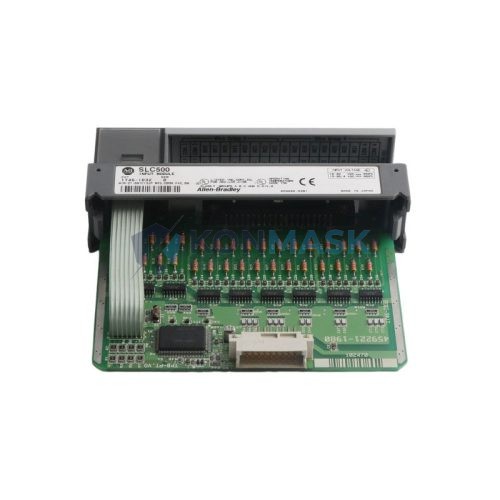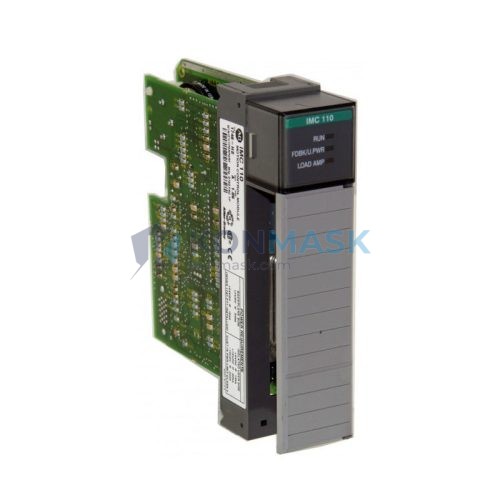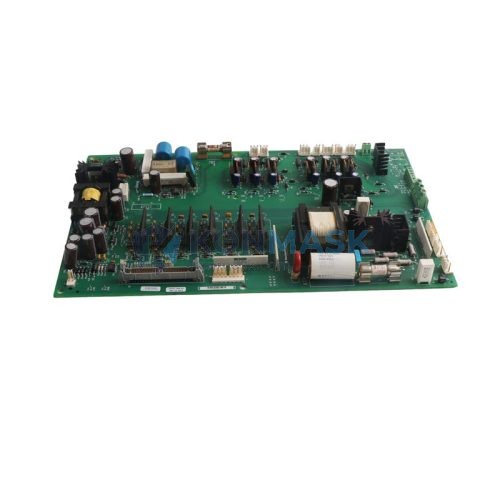

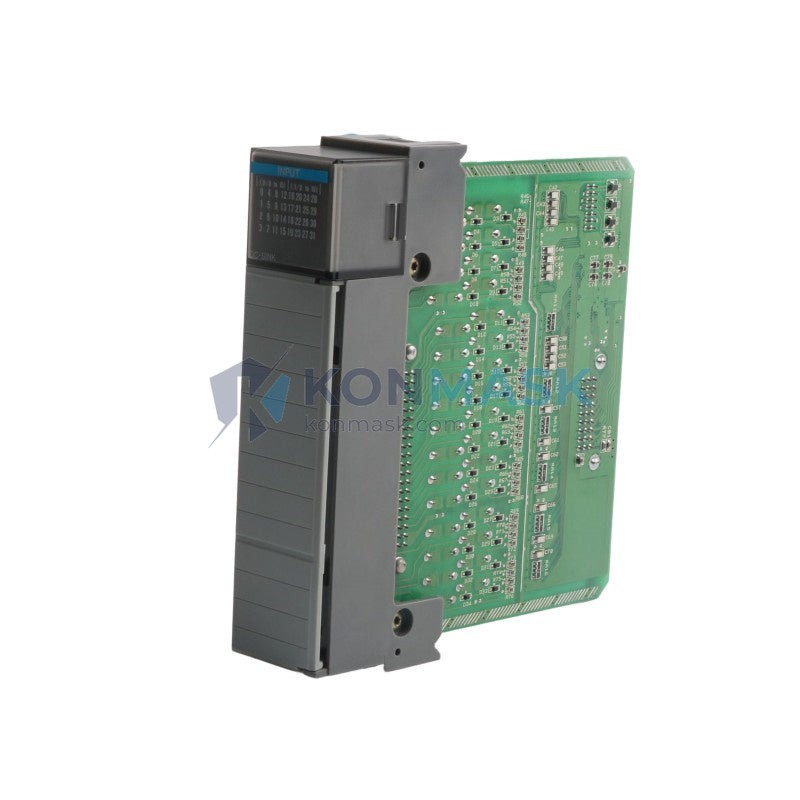
Allen-Bradley 1746-NIO4V — High Resolution Analog Input/Output Module | SLC 500 Platform
Engineering Background: The Allen-Bradley SLC 500 (Small Logic Controller) platform has been a cornerstone of discrete and process control automation since the early 1990s, deployed across tens of thousands of installations in petrochemical refining, power generation, municipal water treatment, and continuous manufacturing. Within the SLC 500 chassis architecture, analog I/O modules serve as the critical interface layer between field instrumentation — transmitters, positioners, and transducers — and the CPU’s control logic. The 1746-NIO4V occupies a single slot in any SLC 500 fixed or modular chassis and provides simultaneous analog input and output capability, eliminating the need for separate dedicated input and output modules in space-constrained panel designs.
Product Positioning: The 1746-NIO4V is the voltage-mode variant of the NIO4 series, distinguished from the 1746-NIO4I (current-mode) by its ±10V input/output range — making it the correct selection for applications using voltage-output transmitters, servo drives with analog command interfaces, or valve positioners requiring ±10V reference signals. It is not a drop-in replacement for the NIO4I in 4–20mA loop-powered circuits without signal conditioning. The module is suited for installations requiring high-resolution process variable feedback (16-bit effective resolution) where standard 12-bit modules introduce unacceptable quantization error in tight PID loops.
Complete Technical Specifications
Electrical
- Input Channels: 4 (voltage, differential)
- Output Channels: 4 (voltage, single-ended)
- Input Voltage Range: ±10V DC
- Output Voltage Range: ±10V DC
- Resolution: 16-bit (input); 16-bit (output)
- Input Impedance: ≥ 10 MΩ
- Output Drive Capability: ≥ 2 mA (5 kΩ minimum load)
- Accuracy: ±0.1% of full scale (at 25°C)
- Backplane Current Draw: 150 mA @ 5V DC; 0 mA @ 24V DC
- Isolation: 500V AC (field-to-backplane)
- Update Rate: Configurable per channel; typical 5–10 ms per channel
Mechanical
- Form Factor: Single-slot SLC 500 I/O module
- Connector: 40-pin RTB (Removable Terminal Block), screw-type
- Dimensions: Standard SLC 500 module profile
- Weight: Approx. 300 g
- Keying: Mechanical keying via RTB key set
Environmental
- Operating Temperature: 0°C to +60°C
- Storage Temperature: -40°C to +85°C
- Relative Humidity: 5% to 95% (non-condensing)
- Vibration: 2g @ 10–500 Hz (IEC 68-2-6)
- Shock: 30g operational (IEC 68-2-27)
- Pollution Degree: 2
Certifications
- UL Listed (UL 508)
- CE Marked (EMC Directive, Low Voltage Directive)
- CSA Certified
- RoHS Compliant
Specification data sourced from Rockwell Automation Publication 1746-UM005 (SLC 500 Analog I/O Modules User Manual) and 1746-NIO4V product datasheet. Verify against current Rockwell documentation for safety-critical applications.
Proven Application Environments
- Petrochemical Refining — Crude distillation column temperature profiling; multi-point thermocouple transmitter arrays operating under continuous 24/7 duty with ±0.5°C setpoint tolerance requirements.
- Thermal Power Generation — Boiler feedwater flow control loops; 4-channel simultaneous feedback from differential pressure transmitters driving proportional valve positioners at ±10V command.
- Municipal Water Treatment — Dosing pump speed reference and flow meter feedback in chlorination and coagulation stages; environments with high humidity and chemical vapor exposure.
- Pulp & Paper Manufacturing — Web tension control systems; high-resolution position feedback from dancer roll transducers requiring 16-bit resolution to prevent web breaks at high line speeds.
- Automotive Assembly — Robotic welding cell analog command interfaces; servo amplifier ±10V reference signals for weld gun positioning with sub-millimeter repeatability.
- HVAC & Building Automation — Central chiller plant capacity control; simultaneous monitoring of chilled water supply/return temperatures and modulation of variable-speed drive references.
Engineering Advantages
- For tight PID control loops with slow-moving process variables, this analog I/O module delivers 16-bit resolution, because finer quantization steps reduce limit cycling and improve steady-state error to under 0.1% of span.
- For panel designs with limited chassis slots, this module combines 4 inputs and 4 outputs in a single slot, because the NIO4V architecture integrates both I/O functions on one backplane connection, freeing slots for additional discrete or specialty modules.
- For installations requiring field wiring isolation, this module provides 500V AC field-to-backplane isolation, because the transformer-coupled isolation barrier prevents ground loop currents from corrupting analog signals in electrically noisy industrial environments.
- For maintenance teams performing hot-swap field wiring changes, this module uses a removable terminal block (RTB), because the RTB can be disconnected and reconnected without disturbing the module or chassis, reducing mean time to repair.
- For multi-vendor instrumentation environments, this module accepts ±10V differential inputs, because differential measurement rejects common-mode noise induced by long cable runs in high-EMI areas such as motor control centers.
- For legacy SLC 500 systems requiring life extension, this module is fully backward-compatible with all SLC 500 chassis and processors (SLC 5/01 through 5/05), because it uses the standard SLC 500 backplane protocol without firmware dependencies on specific CPU revisions.
System Architecture & Signal Flow
Signal Flow: Field voltage signals (±10V) enter via the RTB differential input terminals → onboard anti-aliasing filter → 16-bit ADC → backplane data register → SLC 500 CPU input image table (word N:x). For outputs: CPU output image table → backplane → 16-bit DAC → output buffer amplifier → RTB output terminals → field device (valve positioner, drive reference, etc.).
Compatible Chassis & Processors:
- 1746-A4, 1746-A7, 1746-A10, 1746-A13 (SLC 500 modular chassis, 4/7/10/13 slots)
- 1747-L511, L514, L524, L531, L532, L541, L542, L543, L551, L552, L553 (SLC 5/01 through 5/05 processors)
- Compatible because all listed processors use the standard SLC 500 backplane I/O addressing protocol; no special configuration file is required beyond standard analog module setup in RSLogix 500.
Substitution Conditions: The 1746-NIO4I (current-mode, 4–20mA) is the functional substitute when field instruments are loop-powered current transmitters. Direct substitution of NIO4V for NIO4I requires signal conditioning (V/I converter) at each channel. The 1746-NIO4V cannot substitute for 1746-NI4 (input-only) or 1746-NO4V (output-only) modules without corresponding logic changes in the SLC program.
Sourcing & Quality Verification
Konmask.com sources the 1746-NIO4V through established industrial automation distribution channels, including authorized surplus and refurbished inventory from decommissioned OEM and end-user systems. Each unit undergoes the following verification process before dispatch:
- Visual & Physical Inspection: Examination of PCB, connector pins, RTB contacts, and housing for corrosion, burn marks, mechanical damage, or evidence of counterfeit labeling.
- Firmware & Label Verification: Confirmation of catalog number, series letter, and firmware revision against Rockwell Automation part number records.
- Functional Bench Test: Module installed in a live SLC 500 test chassis; all 4 input channels and 4 output channels exercised across the full ±10V range; accuracy verified against calibrated reference.
- Packaging & ESD Protection: Module shipped in anti-static bag with foam insert; RTB included or noted as separate line item if not present.
Documentation available upon request: Test report, product photos (pre-shipment), Rockwell Automation datasheet, certificate of conformance (where applicable), and export compliance documentation (HS code, country of origin).
Procurement Process
- Submit Inquiry: Contact via support@konmask.com or +0086 19859288691 with quantity, required series letter (if specified), and delivery timeline. Alternatively, place order directly through the product page.
- Quotation & Stock Confirmation: A response with confirmed stock status, unit price, lead time, and shipping options will be provided within 24 hours on business days. Expedited response available for urgent plant shutdown requirements.
- Order Fulfillment & Shipment: Orders confirmed before 14:00 CST are typically dispatched same day. Tracking information and pre-shipment inspection photos are provided upon dispatch. DHL, FedEx, and sea freight options available for international orders.
Technical Support: Pre-sales support includes compatibility confirmation, series letter guidance, and RSLogix 500 configuration advice. Post-sales support includes installation troubleshooting and cross-reference assistance for obsolete or discontinued variants.
Technical FAQ
Q: Is the 1746-NIO4V compatible with the SLC 5/05 processor (1747-L553) running EtherNet/IP?
A: Yes. The 1746-NIO4V is fully compatible with the SLC 5/05 (1747-L553) in any supported chassis. The module communicates over the SLC 500 backplane regardless of the CPU’s communication port configuration. EtherNet/IP connectivity is a CPU-level feature and does not affect analog module operation or addressing.
Q: Can the 1746-NIO4V replace a 1746-NIO4I in an existing installation?
A: Not directly. The NIO4V operates on ±10V voltage signals; the NIO4I operates on 4–20mA current signals. Physical substitution requires adding a current-to-voltage signal conditioner on each channel and verifying that the field transmitters can drive a voltage-mode input. The RSLogix 500 program scaling (SCL/SCP instructions) must also be updated to reflect the new input range. Confirm field wiring and transmitter output type before ordering.
Q: Does the 1746-NIO4V carry CE marking, and is it suitable for use in ATEX Zone 2 classified areas?
A: The 1746-NIO4V carries CE marking per the EMC and Low Voltage Directives and is UL 508 listed for industrial control equipment. It is not intrinsically safe and does not carry ATEX or IECEx certification. For Zone 2 installations, the module must be installed in a purged and pressurized enclosure (Ex p) or behind certified Zener barriers/galvanic isolators that provide the required intrinsic safety boundary between the hazardous area field wiring and the safe-area control panel.
© 2026 Konmask.com. All rights reserved.
Original Source: https://Konmask.com
Contact: support@konmask.com | +0086 19859288691