
AMD EPYC 7H12 – 64-Core High-Density Server Processor | Rome SP3 Platform
Engineering Background
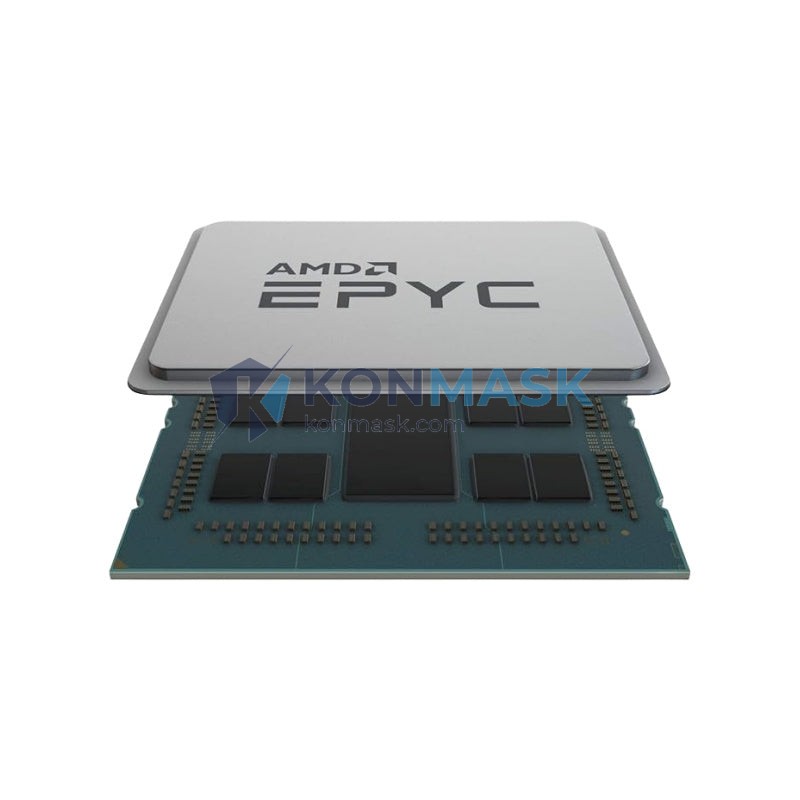
The AMD EPYC 7H12 is a purpose-engineered high-density compute processor from AMD’s second-generation EPYC “Rome” family, built on TSMC 7nm FinFET process technology. Designed specifically for hyperscale and HPC workloads where maximum core density and memory bandwidth are the primary design constraints, the 7H12 operates at a 280W TDP envelope — the highest in the Rome lineup — delivering sustained multi-threaded throughput for mission-critical server deployments.
Product Positioning
Konmask.com supplies the AMD EPYC 7H12 to procurement engineers and system integrators requiring verified, traceable server CPU inventory for data center builds, HPC cluster expansions, and industrial compute infrastructure. This processor is positioned as a premium density-optimized compute node component for SP3-platform server platforms from Dell EMC, HPE, Lenovo, Supermicro, and Gigabyte.
Complete Technical Specifications
| Model | AMD EPYC 7H12 |
| Codename | Rome (2nd Gen EPYC) |
| Process Node | TSMC 7nm FinFET (N7) |
| Core / Thread Count | 64 Cores / 128 Threads |
| Base Clock | 2.6 GHz |
| Max Boost Clock | 3.3 GHz |
| L3 Cache | 256 MB (8 × 32 MB CCX) |
| Socket | SP3 (LGA 4094) |
| TDP | 280W |
| cTDP Range | 225W – 280W |
| Memory Channels | 8-Channel DDR4 |
| Max Memory Speed | DDR4-3200 |
| Max Memory Capacity | 4 TB (with 3DS RDIMMs) |
| PCIe Version | PCIe 4.0 |
| PCIe Lanes (per CPU) | 128 lanes |
| PCIe Lanes (dual-socket) | 256 lanes |
| Multi-Socket Support | 2P (dual-socket) |
| Instruction Set | x86-64, AVX2, AVX-512 |
| Virtualization | AMD-V, AMD-Vi (IOMMU) |
| Security Features | AMD SEV, SME, PSP |
| OPN (Ordering Part Number) | 100-000000055 |
| Package | OEM Tray |
Proven Application Environments
- Hyperscale Data Centers — High-density 1U/2U node deployments requiring maximum core count per rack unit
- HPC Clusters — CFD, FEA, molecular dynamics, and seismic modeling workloads leveraging AVX-512 and large L3 cache
- AI/ML Inference Infrastructure — CPU-side preprocessing and inference serving alongside GPU accelerators
- Virtualization Hosts — VMware vSphere, KVM, and Hyper-V environments with high VM density requirements
- In-Memory Databases — SAP HANA, Redis, and VoltDB deployments exploiting 8-channel DDR4 bandwidth
- Industrial Compute Nodes — Real-time simulation, SCADA backend processing, and edge analytics servers
- Telco / NFV Platforms — Network function virtualization requiring high PCIe lane count and IOMMU support
Engineering Advantages
- Maximum Core Density in Rome Family — 64 cores per socket; up to 128 cores in dual-socket configurations without additional licensing overhead
- 256 MB L3 Cache — Industry-leading cache capacity at launch; reduces DRAM access latency for cache-sensitive workloads
- PCIe 4.0 × 128 Lanes — Full bandwidth for NVMe storage arrays, high-speed NICs, and GPU interconnects simultaneously
- 8-Channel DDR4-3200 — Aggregate memory bandwidth exceeding 200 GB/s per socket for memory-bound applications
- AMD SEV / SME — Hardware-level memory encryption for secure multi-tenant and confidential computing deployments
- Chiplet Architecture — 8 × CCD (Core Complex Die) + 1 × IOD design enables superior yield and consistent performance across production lots
- SP3 Platform Longevity — Compatible with 1st and 2nd Gen EPYC motherboards; broad OEM ecosystem support
System Architecture & Signal Flow
The EPYC 7H12 implements AMD’s Infinity Fabric interconnect architecture. Each of the 8 Core Complex Dies (CCDs) contains 8 cores and 32 MB L3 cache, connected via the central I/O Die (IOD) fabricated on GlobalFoundries 14nm. The IOD hosts all memory controllers (8× DDR4), PCIe 4.0 root complexes (128 lanes total), and inter-socket Infinity Fabric links for 2P configurations.
In dual-socket deployments, the two IODs communicate via 3× Infinity Fabric links per direction, providing approximately 340 GB/s of inter-socket bandwidth. NUMA topology is exposed to the OS as 8 NUMA nodes per socket (NPS4 mode) or consolidated into 1–4 nodes depending on BIOS configuration, enabling workload-specific memory locality optimization.
PCIe 4.0 lanes are distributed across the IOD as: 1× ×16 + 4× ×16 + additional ×8/×4 segments, supporting direct attachment of NVMe SSDs, 100GbE NICs, and GPGPU cards without PCIe switch overhead.
Sourcing & Quality Verification
- Source — Procured from authorized AMD distribution channels and verified OEM decommission pipelines
- Inspection — Each unit undergoes visual inspection for IHS integrity, LGA pin condition, and OPN laser marking verification
- Authenticity — OPN and S-Spec codes cross-referenced against AMD ARK database prior to listing
- Condition — New (sealed tray) or Refurbished (tested, cleaned, re-trayed) — condition specified at order confirmation
- Warranty — 90-day functional warranty; DOA replacement within 7 business days of delivery confirmation
- Documentation — Certificate of conformance and test report available upon request for enterprise procurement
Procurement Process
- Inquiry — Submit quantity and delivery timeline requirements via support@konmask.com or WhatsApp +0086 19859288691
- Quote — Formal quotation issued within 1 business day including unit price, lead time, and shipping options
- Order Confirmation — Purchase order or online checkout; proforma invoice issued for bank transfer orders
- Quality Check — Pre-shipment inspection completed; photos/test reports shared upon request
- Shipment — DHL / FedEx / SF Express with full tracking; export documentation (commercial invoice, packing list, COO) included
- After-Sales — Technical support available for integration questions; RMA process initiated within 48 hours of issue report
Technical FAQ
Q: Is the EPYC 7H12 compatible with 1st Gen EPYC (Naples) motherboards?
A: No. The 7H12 requires SP3 motherboards validated for 2nd Gen EPYC (Rome). Naples boards use the same SP3 socket physically but require BIOS updates that may not be available for all Naples-era platforms. Verify with your OEM’s CPU compatibility list.
Q: What cooling solution is required for 280W TDP?
A: AMD specifies a minimum heatsink rated for ≥280W. For 1U deployments, high-static-pressure fans (≥60 CFM per CPU zone) are required. Liquid cooling (direct-to-chip or immersion) is recommended for sustained all-core workloads in thermally constrained enclosures.
Q: Can the 7H12 run in single-socket (1P) configuration?
A: Yes. The 7H12 operates fully in 1P mode. The second socket can remain unpopulated. PCIe lane count and memory channels remain at full 128-lane / 8-channel capacity in 1P mode.
Q: What is the difference between EPYC 7H12 and EPYC 7742?
A: Both are 64-core Rome processors. The 7H12 has a higher TDP (280W vs 225W) and higher boost clock (3.3 GHz vs 3.4 GHz base/boost trade-off), optimized for sustained throughput in high-density thermal envelopes. The 7742 is the standard SKU; the 7H12 is the HPC/hyperscale variant.
Q: Is bulk / OEM pricing available?
A: Yes. Volume pricing tiers are available for orders of 5+ units. Contact support@konmask.com with your project requirements for a custom quote.
© 2026 Konmask.com. All rights reserved.
Original Source: https://Konmask.com
Contact: support@konmask.com | +0086 19859288691