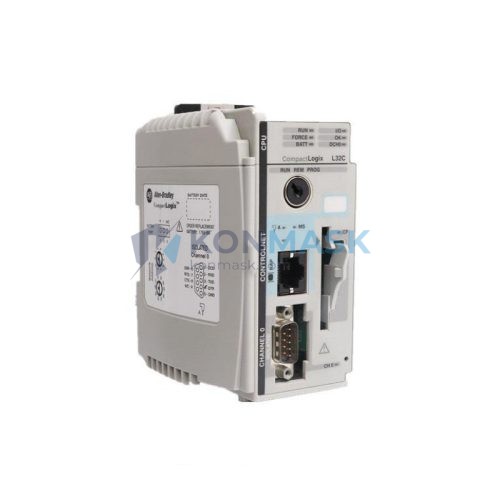

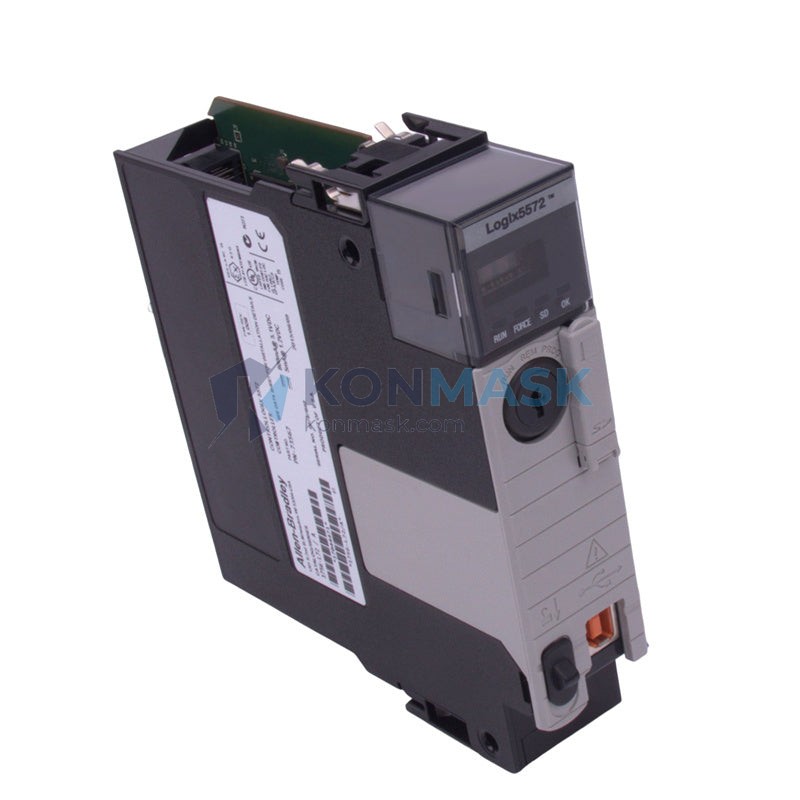
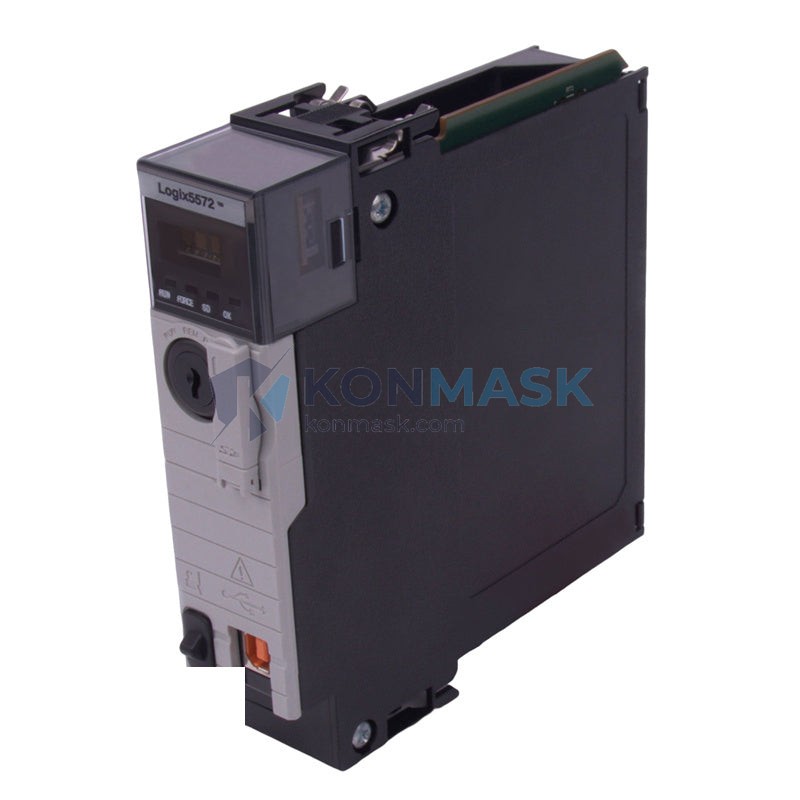
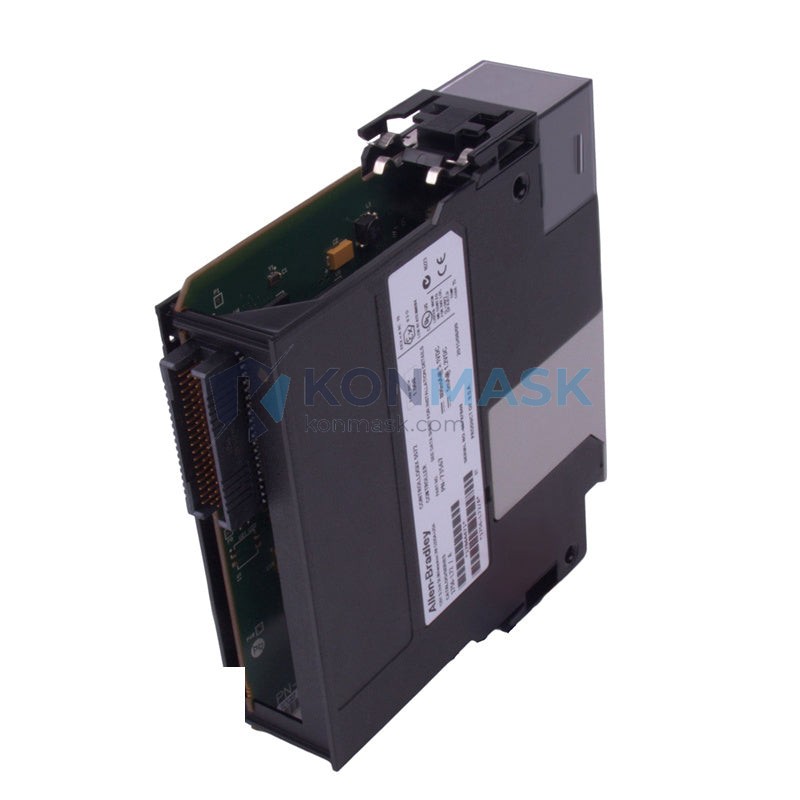
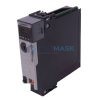
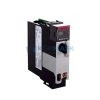
Allen-Bradley 1756-L72 – Logix5572 Dual-Port EtherNet/IP Controller | ControlLogix 5570 Platform
Engineering Background: The ControlLogix 5570 platform (1756 chassis) is Rockwell Automation’s flagship process and discrete control architecture, deployed across safety-critical continuous-process industries where deterministic scan times, high-availability redundancy, and deep I/O scalability are non-negotiable. Within this architecture, the L7x controller family introduced integrated dual-port EtherNet/IP with Device Level Ring (DLR) topology support, eliminating the need for a separate 1756-ENBT communication module for primary network connectivity. The 1756-L72 occupies the mid-tier of the L7x range, providing 4 MB of user memory — sufficient for complex ladder/FBD/SFC programs with extensive data logging, PID loops, and motion coordination without the cost premium of the L73/L74/L75 variants.
Product Positioning: The 1756-L72 targets applications requiring more than the 2 MB ceiling of the 1756-L71 but where the 8 MB (L73) or larger footprint is over-specified. Its dual-port EtherNet/IP enables linear or DLR network topologies without an external switch, making it the preferred choice for mid-scale process cells, skid-mounted packaged equipment, and distributed control nodes that must maintain network resilience. It is not suited for applications requiring SIL 2/3 safety functions (use 1756-L7xS GuardLogix variants) or motion axis counts exceeding the firmware-defined limit without supplemental motion modules.
Complete Technical Specifications
Electrical
- Catalog Number: 1756-L72
- Controller Series: ControlLogix 5570 (Logix5572)
- User Memory: 4 MB
- I/O Memory: 478 KB
- Tasks: 32 (1 continuous + 31 periodic/event)
- Programs per Task: 100
- EtherNet/IP Ports: 2 × RJ-45 (integrated, 10/100 Mbps)
- Network Topology Support: Linear, Star, Device Level Ring (DLR)
- USB Port: 1 × USB Type-B (programming/configuration)
- Backplane Current Draw: 1.2 A @ 5 VDC; 3.0 mA @ 24 VDC
- Power Dissipation: 6.1 W (max)
- Supported Languages: Ladder Diagram (LD), Function Block Diagram (FBD), Structured Text (ST), Sequential Function Chart (SFC)
- Motion Control: Integrated (CIP Motion via EtherNet/IP)
- Redundancy: Supported (requires 1756-RM2/A redundancy module)
Mechanical
- Form Factor: Single-slot ControlLogix 1756 chassis module
- Dimensions (H × W × D): 94.0 mm × 34.5 mm × 115.6 mm (approx.)
- Weight: ~250 g
- Chassis Compatibility: Any 1756-Axxx chassis (4, 7, 10, 13, 17-slot)
- Slot Position: Any slot (slot 0 recommended for primary controller)
- SD Card Slot: 1 × SD (nonvolatile program/data storage)
Environmental
- Operating Temperature: 0 °C to +60 °C
- Storage Temperature: −40 °C to +85 °C
- Relative Humidity: 5% to 95% (non-condensing)
- Vibration: 2 g @ 10–500 Hz (IEC 60068-2-6)
- Shock: 30 g operational; 50 g non-operational (IEC 60068-2-27)
- Pollution Degree: 2
- IP Rating: IP20 (chassis-mounted)
- Altitude: Up to 2000 m without derating
Certifications
- UL Listed (UL 508)
- CE Marked (EMC Directive 2014/30/EU; LVD 2014/35/EU)
- cUL Listed (CSA C22.2 No. 142)
- RCM (Australia/New Zealand)
- ATEX / IECEx: Not rated for Zone 0/1 (use purged enclosure for hazardous areas)
- EAC (Eurasian Conformity)
Data source: Rockwell Automation Publication 1756-TD001, ControlLogix Controllers Technical Data; verified against firmware revision 30.x release notes.
Proven Application Environments
- Petrochemical Refining: Crude distillation unit (CDU) — continuous 24/7 operation with redundant controller pair (1756-L72 + 1756-RM2), managing 400+ analog PID loops under high-temperature process upsets.
- Thermal Power Generation: Boiler combustion management system (BMS) — coordinating fuel/air ratio control and burner sequencing with deterministic 10 ms scan time across a 17-slot 1756 chassis.
- Municipal Water Treatment: SCADA-integrated filtration and dosing skid — DLR topology connecting 1756-L72 to distributed 1734 POINT I/O drops over a single fiber ring, tolerating single-point cable faults without process interruption.
- Pharmaceutical Manufacturing: CIP/SIP (Clean-In-Place/Steam-In-Place) skid — FBD-based recipe execution with full audit trail logging to SD card, supporting 21 CFR Part 11 data integrity requirements.
- Mining & Mineral Processing: SAG mill drive coordination — CIP Motion over EtherNet/IP synchronizing variable-frequency drives, with event-triggered tasks responding to vibration sensor alarms within 1 ms.
- Wastewater Treatment: Aeration basin dissolved-oxygen control — multi-loop PID with cascade control, integrated with MCC motor starters via DeviceNet bridge modules in a 10-slot chassis.
Engineering Advantages
- For high-availability continuous-process applications, this controller supports hot-standby redundancy via the 1756-RM2 module, because the chassis backplane synchronizes controller state at every scan cycle, enabling sub-100 ms failover without process upset.
- For network-resilient field installations, this controller’s integrated dual-port EtherNet/IP enables Device Level Ring topology, because DLR provides automatic fault recovery at the media layer without requiring a managed switch or additional hardware.
- For memory-intensive programs with large data tables and historian logging, this controller’s 4 MB user memory accommodates complex multi-task programs, because the Logix5572 processor separates I/O memory (478 KB) from user program memory, preventing data table growth from impacting scan time.
- For multi-language programming teams, this controller supports all four IEC 61131-3 languages simultaneously within a single project, because Studio 5000 Logix Designer allows mixed-language routines within the same program, reducing migration effort from legacy PLC-5 or SLC-500 platforms.
- For applications requiring nonvolatile program backup, this controller’s onboard SD card slot stores the full project image and data values, because the SD card persists through power cycles and firmware updates, eliminating dependency on a connected programming terminal for recovery.
- For skid-mounted OEM equipment with space constraints, this controller occupies a single chassis slot, because the integrated EtherNet/IP ports eliminate the need for a dedicated 1756-ENBT communication module, reducing chassis slot count and overall panel footprint.
System Architecture & Signal Flow
Signal Flow: Field sensors/actuators → 1756 I/O modules (analog/digital) → ControlLogix backplane → 1756-L72 CPU (scan cycle execution: input update → program execution → output update) → EtherNet/IP network → SCADA/HMI (FactoryTalk View SE / Ignition / WinCC) → Historian / MES layer.
Compatible Modules (same 1756 chassis):
- 1756-EN2T / 1756-EN2TR — additional EtherNet/IP bridge modules for segmented network architectures
- 1756-DNB — DeviceNet Scanner for legacy field device integration
- 1756-CN2 — ControlNet Scanner for deterministic peer-to-peer I/O
- 1756-RM2/A — Redundancy Module (required for hot-standby configuration)
- 1756-IB16 / 1756-OB16E — Digital I/O modules (24 VDC)
- 1756-IF8 / 1756-OF8 — Analog I/O modules (4–20 mA / 0–10 V)
- 1756-M02AE — Servo Drive Interface (CIP Motion)
Replacement / Upgrade Conditions: The 1756-L72 directly replaces the 1756-L62 (2 MB, Series B) with a firmware migration and project re-download; no chassis or wiring changes required. Upgrade to 1756-L73 (8 MB) is warranted when user memory utilization exceeds 80% or when axis count requires expanded motion data structures. The 1756-L72S (GuardLogix) variant is required when SIL 2 safety functions must reside in the same chassis.
Sourcing & Quality Verification
Units offered through Konmask.com are sourced from decommissioned plant upgrades, authorized distributor overstock, and verified surplus channels. Each unit undergoes the following 4-step inspection process before dispatch:
- Visual Inspection: Chassis connector pins, front-panel ports, SD slot, and label integrity checked against OEM reference images; any unit with bent pins, corrosion, or label tampering is rejected.
- Firmware Verification: Unit is powered in a test chassis; firmware revision and catalog number are confirmed via RSLinx Classic / Studio 5000 connection; revision is documented on the test report.
- Functional Burn-In: Controller executes a standardized test program for a minimum of 2 hours, verifying backplane communication, EtherNet/IP port activity, and SD card read/write cycles.
- Packaging & ESD Protection: Unit is wrapped in anti-static foam, sealed in an ESD bag, and shipped in double-wall corrugated carton with desiccant.
Documentation available upon request:
- Test report (firmware revision, burn-in duration, pass/fail status)
- Rockwell Automation product lifecycle status confirmation
- Certificate of conformance (CoC)
- Original OEM datasheet (1756-TD001)
Procurement Process
- Inquiry Submission: Send catalog number, required quantity, target delivery date, and any firmware revision requirements to support@konmask.com or via the product page inquiry form. A quotation with availability confirmation is returned within 24 hours on business days.
- Order Confirmation & Payment: Upon quotation acceptance, a proforma invoice is issued. Payment terms and shipping method are confirmed; units are reserved from verified stock upon payment receipt.
- Dispatch & Documentation: Units ship with test report, packing list, and CoC. Tracking information is provided within 24 hours of dispatch. Express freight options (DHL/FedEx) are available for urgent requirements.
Technical Support: Pre-sales engineering support is available for compatibility verification, firmware revision matching, and redundancy configuration guidance. Post-sales support covers installation verification and Studio 5000 project import assistance. Contact: support@konmask.com | +0086 19859288691.
Technical FAQ
Q: Is the 1756-L72 compatible with existing 1756-L62 projects without reprogramming?
A: The project file (.ACD) created for a 1756-L62 can be opened in Studio 5000 and retargeted to the 1756-L72 (Logix5572) controller type. A full download to the new controller is required. I/O module configurations, tag databases, and network parameters are preserved. Verify that firmware revision on the replacement unit matches or exceeds the revision used during project development to avoid instruction set compatibility issues.
Q: Can the 1756-L72 replace a 1756-L71 (2 MB) in a running redundant system?
A: Yes, with conditions. Both controllers in a redundant pair must be identical catalog numbers and firmware revisions. Replacing only one controller in a pair requires the replacement unit to be loaded with matching firmware before insertion. A qualified controls engineer should perform the swap during a planned maintenance window following Rockwell Publication 1756-UM535 (ControlLogix Redundancy User Manual) procedures.
Q: Is the 1756-L72 approved for use in hazardous (classified) locations such as Zone 1 or Division 1?
A: The 1756-L72 itself carries UL 508 and CE certifications for general industrial environments (Pollution Degree 2, IP20). It is not intrinsically safe and is not rated for direct installation in Zone 0, Zone 1, or Division 1 hazardous locations. Deployment in such environments requires installation within a certified purged-and-pressurized enclosure (NFPA 496 / IEC 60079-2 Type X or Y purging) or placement in a safe area with appropriate field barriers. Consult the site’s area classification drawings and applicable national electrical codes before specifying.
© 2026 Konmask.com. All rights reserved.
Original Source: https://Konmask.com
Contact: support@konmask.com | +0086 19859288691