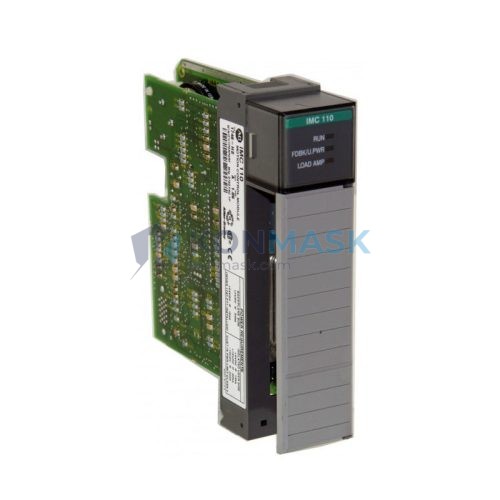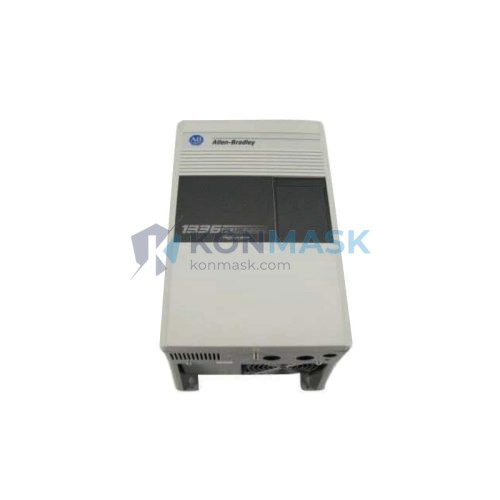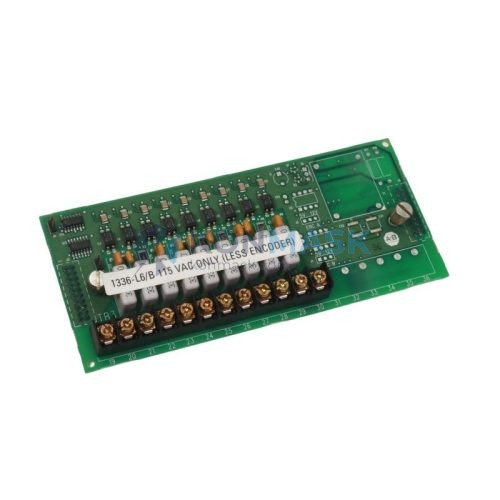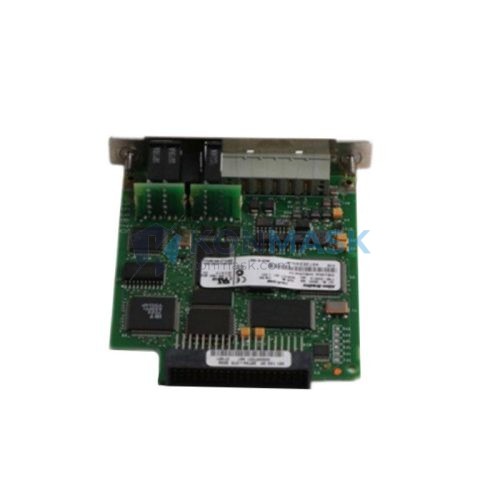

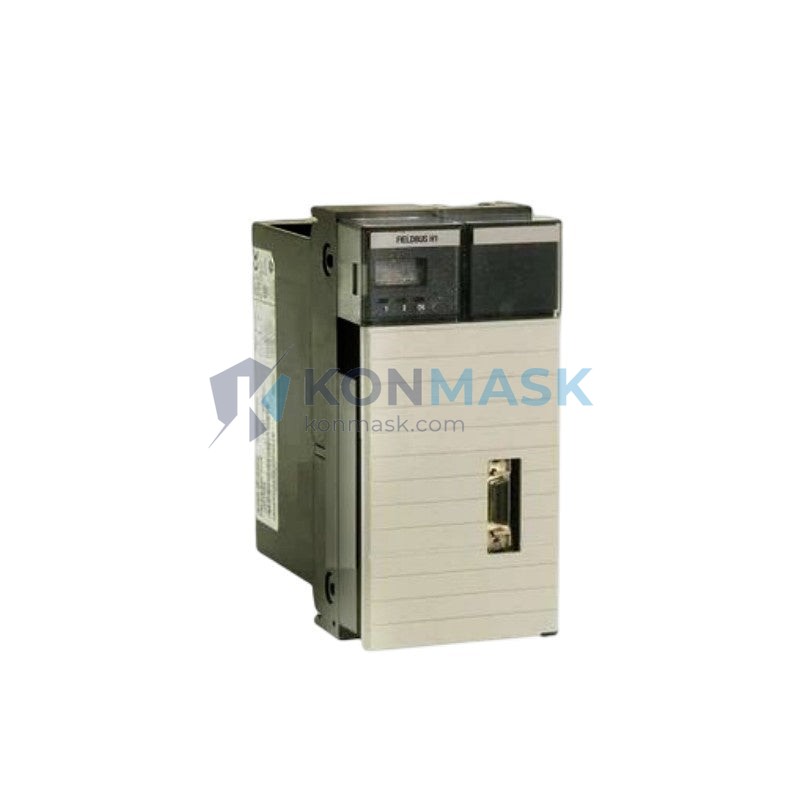
Allen-Bradley 1757-FIM – Fieldbus Interface Module | ControlLogix / PlantPAx Platform
Engineering Background: The Allen-Bradley ControlLogix platform is Rockwell Automation’s flagship process and discrete control architecture, deployed across critical infrastructure in refining, power generation, and water treatment. Within this architecture, the 1757-FIM (Fieldbus Interface Module) serves as the gateway between the ControlLogix backplane and Foundation Fieldbus H1 segments, enabling deterministic, intrinsically safe communication with field instruments without requiring additional marshalling hardware. It occupies a strategic role in any PlantPAx Distributed Control System (DCS) implementation where HART or analog I/O is being migrated to digital fieldbus topology.
Product Positioning: The 1757-FIM is specifically designed for Foundation Fieldbus H1 integration within ControlLogix chassis. Unlike the 1756-DHRIO (which handles DH+/RIO legacy networks) or the 1756-EN2T (Ethernet/IP backbone), the 1757-FIM targets process-intensive applications requiring multi-drop field device communication at 31.25 kbps. It is not a substitute for PROFIBUS DP modules (1756-PDPS) and is not compatible with HSE (High Speed Ethernet) fieldbus segments. Applicable where field device density per segment is 4–16 devices and loop integrity under SIL 2 conditions is required.
Complete Technical Specifications
Electrical
- Communication Protocol: Foundation Fieldbus H1 (IEC 61158 Type 1)
- Fieldbus Speed: 31.25 kbps
- H1 Segments per Module: 2 (independent, individually isolated)
- Backplane Current Draw: 800 mA @ 5 VDC (from ControlLogix chassis)
- Field Power Supply: External FF-compliant power conditioner required (not included)
- Isolation: 500 V AC optical isolation between backplane and fieldbus segments
- Link Active Scheduler (LAS): Supported; module can act as primary or backup LAS
Mechanical
- Form Factor: Single-slot ControlLogix chassis module
- Dimensions: 94 mm H × 35 mm W × 87 mm D (standard 1756 profile)
- Weight: Approx. 300 g
- Connector: 2 × 9-pin D-sub (DB9) for H1 segment termination
- Chassis Compatibility: 1756-A4, 1756-A7, 1756-A10, 1756-A13, 1756-A17 (all ControlLogix chassis)
Environmental
- Operating Temperature: 0 °C to +60 °C
- Storage Temperature: −40 °C to +85 °C
- Relative Humidity: 5% to 95% non-condensing
- Vibration: IEC 68-2-6, 2 g @ 10–500 Hz
- Shock: IEC 68-2-27, 30 g
- Enclosure Rating: IP20 (requires installation in rated enclosure for harsh environments)
Certifications
- UL Listed: UL 508 (Industrial Control Equipment)
- CE Marking: EMC Directive 2014/30/EU; Low Voltage Directive 2014/35/EU
- Fieldbus Foundation Registered: ITK 6.x compliant
- RoHS Compliant: Yes
- ATEX / IECEx: Not rated for Zone 0/1 direct installation; use with certified barriers for hazardous area field devices
Data sourced from Rockwell Automation Publication 1757-UM001 (1757-FIM User Manual) and Fieldbus Foundation ITK 6.x registration records. Specifications subject to revision; verify against current Rockwell publication before final engineering design.
Proven Application Environments
- Petroleum Refining – Crude Distillation Unit: Continuous column temperature and pressure profiling via FF H1-connected transmitters; module maintains LAS function during DCS controller redundancy switchover, ensuring uninterrupted scan cycle.
- Power Generation – Boiler Combustion Control: Multi-drop H1 segment connecting 8 × Rosemount 3051 pressure transmitters and 4 × Fisher DVC6200 valve positioners; deterministic scheduling eliminates polling latency critical to combustion trim loops.
- Water Treatment – Membrane Filtration Plant: Integration of Endress+Hauser Promag flowmeters and Liquiline CM442 analyzers on a single H1 segment; reduces field cable runs by 60% versus conventional 4–20 mA wiring.
- Chemical Processing – Reactor Temperature Control: Redundant H1 segments (one per module port) providing fault-tolerant loop integrity for exothermic reactor jacket control; supports SIL 2 loop architecture with certified barriers.
- Pulp & Paper – Recovery Boiler: High-vibration environment with 24/7 continuous operation; module’s optical isolation prevents ground loop interference from high-current motor drives sharing the same cable tray infrastructure.
- Pharmaceutical – CIP/SIP Skid Automation: PlantPAx DCS implementation with FDA 21 CFR Part 11 audit trail requirements; FF H1 device parameter history accessible via AMS Device Manager through the 1757-FIM backplane interface.
Engineering Advantages
- For multi-drop field device topologies, this fieldbus interface module eliminates individual 4–20 mA home-run cables, because a single H1 segment supports up to 16 devices on one twisted-pair trunk, reducing installed wiring cost by up to 40%.
- For process plants requiring deterministic control, this module’s Link Active Scheduler function guarantees cyclic data exchange at fixed intervals, because LAS-controlled token passing eliminates the non-determinism inherent in polling-based protocols.
- For ControlLogix redundancy architectures, this module integrates natively into the 1756 chassis without a separate gateway, because it communicates directly over the ControlLogix backplane, reducing latency and eliminating a potential single point of failure.
- For hazardous area installations, this module supports intrinsically safe field devices via certified Zener barriers or galvanic isolators, because its 500 V optical isolation maintains segment integrity even when barrier ground faults occur.
- For plants using AMS Device Manager or FactoryTalk AssetCentre, this module provides transparent pass-through access to FF device parameters and diagnostics, because the backplane interface exposes the full FBAP (Function Block Application Process) object model.
- For maintenance teams performing hot-swap operations, this module supports removal and insertion under power (RIUP) within the ControlLogix chassis, because the backplane architecture isolates module power sequencing from the running controller scan.
System Architecture & Signal Flow
Signal Flow: Field instrument (FF H1 device) → H1 trunk cable → DB9 segment connector on 1757-FIM → optical isolation barrier → ControlLogix backplane → 1756-L series controller (e.g., 1756-L71, 1756-L83E) → FactoryTalk View / PlantPAx HMI.
Compatible Controllers & Modules:
- 1756-L6x / 1756-L7x / 1756-L8x series ControlLogix controllers – native backplane communication, no additional configuration required.
- 1756-RM2 Redundancy Module – 1757-FIM participates in redundant chassis pairs; LAS backup function activates automatically on primary chassis failure.
- 1756-EN2T / 1756-EN3TR – Ethernet/IP bridge modules in the same chassis provide remote access to FF device diagnostics via Studio 5000 online mode.
- AMS Device Manager 14.x+ – connects via ControlLogix backplane to access FF device configuration, calibration records, and NAMUR NE107 diagnostic alerts.
Substitution Conditions: The 1757-FIM may be replaced by the Rockwell FFLD (Fieldbus Linking Device) in architectures migrating to EtherNet/IP-based HSE infrastructure, but this requires segment re-engineering and controller tag remapping. Direct drop-in substitution is not supported across different fieldbus protocols.
Sourcing & Quality Verification
Units are sourced through established industrial automation supply channels with documented chain of custody. All modules undergo a 4-step incoming inspection before dispatch:
- Visual Inspection: Enclosure integrity check, connector pin condition, label legibility, and firmware revision label verification against Rockwell published revision history.
- Backplane Continuity Test: Module seated in test chassis (1756-A4) with 1756-L71 controller; RSLogix 5000 / Studio 5000 module recognition and I/O tree population confirmed.
- H1 Segment Loopback Test: Both DB9 ports tested with FF H1 loopback adapter; LAS function and cyclic data exchange verified at 31.25 kbps.
- Firmware Revision Documentation: Installed firmware version recorded and cross-referenced against Rockwell Security Advisory database for known vulnerabilities prior to shipment.
Documentation available upon request: Test report, firmware revision record, Rockwell product traceability reference, and packing inspection certificate.
Procurement Process
- Submit Inquiry: Provide target quantity, required firmware revision (if specified), and delivery timeline via the contact form or email at support@konmask.com. Include your project PO number or RFQ reference for expedited processing.
- Quotation & Stock Confirmation: A response with confirmed stock status, unit price (HKD/USD), lead time, and shipping options will be provided within 24 hours on business days. Urgent requirements can be flagged for same-day response.
- Order Fulfillment: Upon PO confirmation, units are inspected, packed with ESD protection, and dispatched with full documentation. DHL Express, FedEx International Priority, and sea freight consolidation are available depending on order volume and destination.
Technical Support: Pre-sales application engineering support is available for system architecture questions, compatibility verification, and firmware revision guidance. Post-sales support covers installation verification and Studio 5000 configuration assistance.
Technical FAQ
Q: Is the 1757-FIM compatible with both ControlLogix and CompactLogix platforms?
A: The 1757-FIM is designed exclusively for the 1756 ControlLogix chassis backplane. It is not compatible with CompactLogix (1769 series) or SoftLogix platforms. CompactLogix applications requiring Foundation Fieldbus H1 connectivity require a standalone FF linking device connected via EtherNet/IP.
Q: Can the 1757-FIM replace a 1757-FFLD (Fieldbus Linking Device) in an existing installation?
A: These are architecturally different products. The 1757-FIM is a backplane-resident module; the 1757-FFLD is a standalone DIN-rail device communicating via EtherNet/IP. Migration from FFLD to FIM requires chassis slot availability, controller tag remapping in Studio 5000, and re-commissioning of all H1 segment device addresses. Direct substitution without re-engineering is not supported.
Q: Does the 1757-FIM carry SIL certification for use in safety-instrumented systems?
A: The 1757-FIM itself is not SIL-rated as a standalone component. For SIL 2 loop architectures, it is used in combination with SIL-certified field devices, certified intrinsic safety barriers, and a SIL-capable controller (e.g., 1756-L7xS GuardLogix). The overall SIL rating of the loop must be validated through a functional safety assessment per IEC 61511 by a qualified functional safety engineer.
© 2026 Konmask.com. All rights reserved.
Original Source: https://Konmask.com
Contact: support@konmask.com | +0086 19859288691