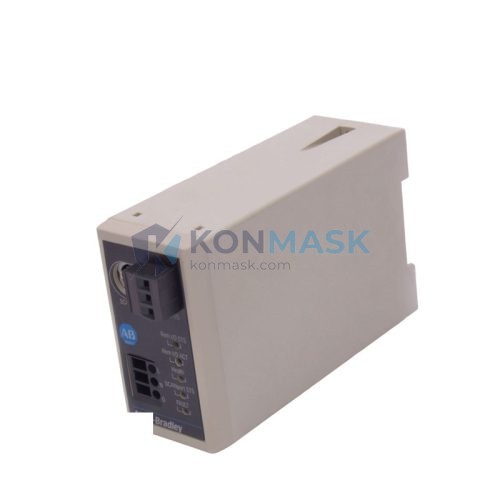

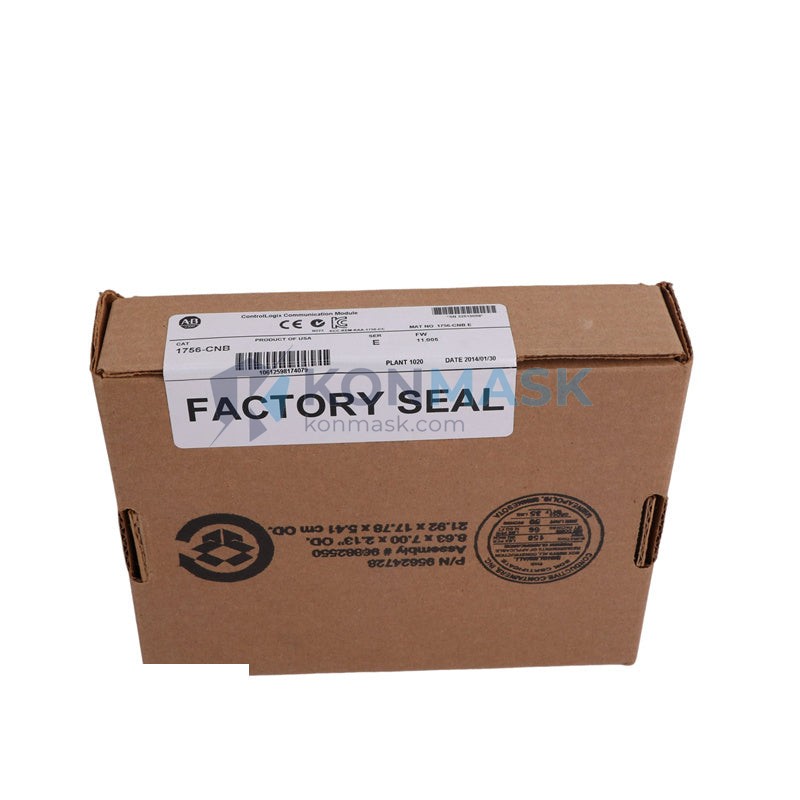
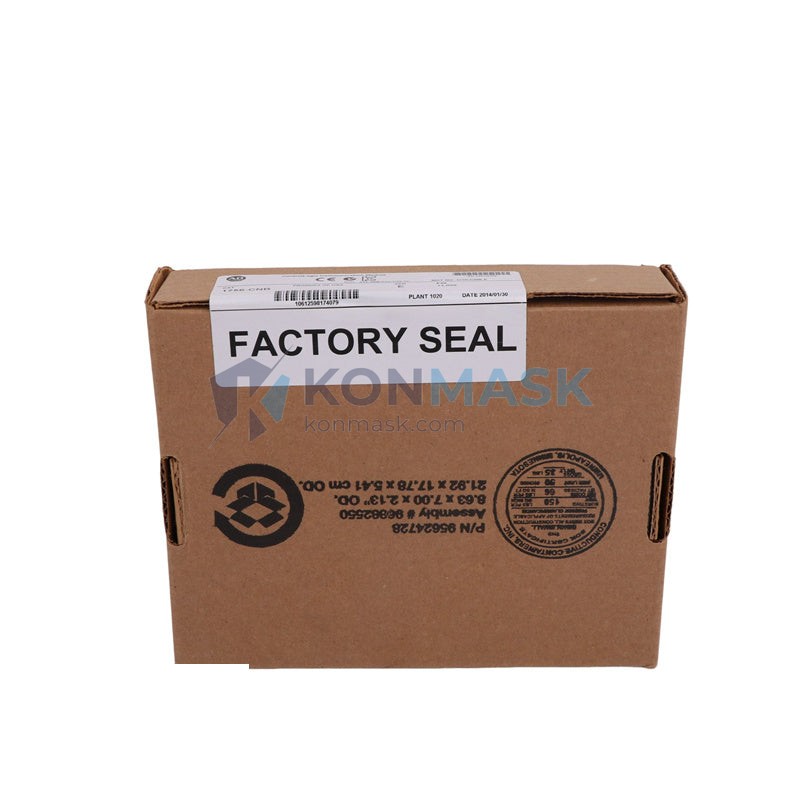
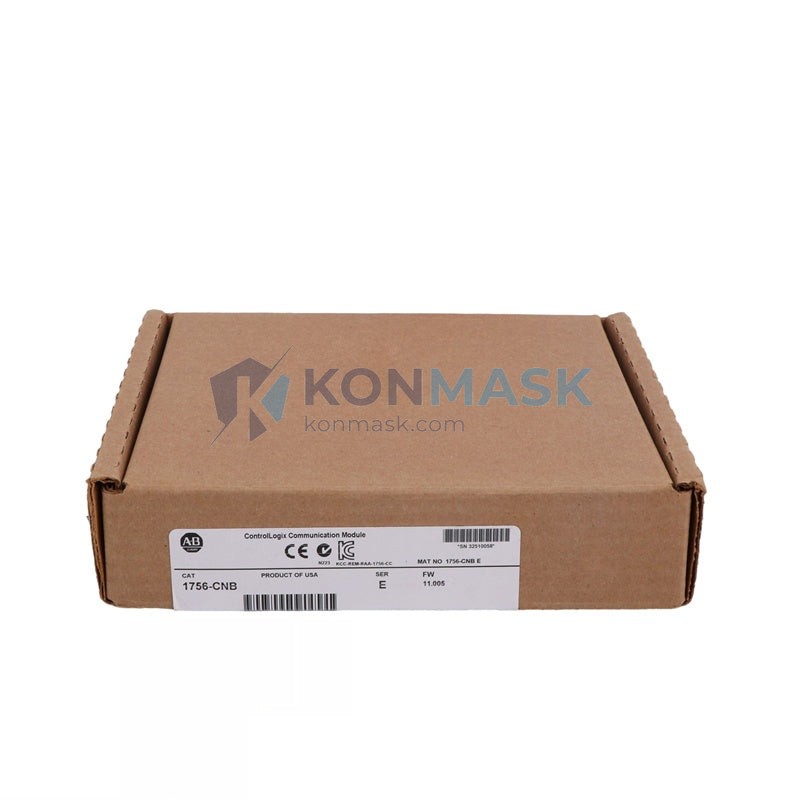
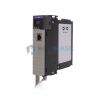
Allen-Bradley 1756-CNB ControlNet Bridge Module – ControlLogix 1756 Series
Picture a continuous casting line at a steel mill running at full capacity — dozens of remote I/O racks, drives, and motion controllers exchanging deterministic data every millisecond. Now imagine the ControlNet bridge goes offline. Within seconds, the PLC loses visibility of field devices, safety interlocks cannot confirm actuator states, and the entire line trips on a fault. Recovery means hours of downtime, scrap material, and a maintenance crew tracing a single failed module. The 1756-CNB exists precisely to prevent that scenario: it is the gateway that keeps ControlLogix talking to the ControlNet network with the deterministic, scheduled bandwidth that process-critical applications demand.
Within the 1756 ControlLogix platform, the 1756-CNB occupies a specific and non-substitutable role. Unlike Ethernet/IP bridges that rely on unscheduled, best-effort traffic, the 1756-CNB implements ControlNet’s dual-media, time-scheduled protocol — guaranteeing that every node receives its data within a defined Network Update Time (NUT). Installed in hundreds of thousands of process, hybrid, and discrete manufacturing sites worldwide since its introduction, this module remains the reference design for deterministic ControlNet communication in Rockwell Automation architectures.
Technical Specifications
Electrical
- Backplane Current Draw: 1.0 A @ 5 VDC; 3.0 mA @ 24 VDC
- Power Dissipation: 5.0 W (max)
- ControlNet Port: BNC coaxial, dual-port (redundant media capable)
- Network Data Rate: 5 Mbps (ControlNet standard)
- Scheduled Connections: Up to 64 scheduled connections
- Unscheduled Connections: Up to 64 unscheduled connections
- Maximum Nodes per Network: 99
Mechanical
- Form Factor: Single-slot 1756 ControlLogix chassis module
- Dimensions: 94.0 mm H × 54.9 mm W × 87.6 mm D (standard 1756 profile)
- Weight: Approx. 350 g
- Connector: 1756 backplane edge connector
Environmental
- Operating Temperature: 0 °C to +60 °C
- Storage Temperature: −40 °C to +85 °C
- Relative Humidity: 5% to 95% non-condensing
- Vibration: IEC 68-2-6 (5–2000 Hz, 2 g)
- Shock: IEC 68-2-27 (30 g operational)
- Enclosure Rating: Open type; requires installation in suitable enclosure per NFPA 79
Certifications & Standards
- UL Listed: UL 508
- CE Marked: EMC Directive 2014/30/EU; Low Voltage Directive 2014/35/EU
- ControlNet International: CI conformance tested
- ATEX / Class I Div 2: Consult Rockwell publication 1756-TD001 for hazardous location ratings
- Industry Standard: IEC 61158 (ControlNet fieldbus standard)
Key Features & Benefits
- Deterministic Scheduled Bandwidth — ControlNet’s time-scheduled protocol guarantees data delivery within a configurable NUT (typically 2–100 ms), eliminating the jitter that causes nuisance trips in motion and process control loops.
- Dual Redundant Media Ports — Two independent BNC coaxial ports allow parallel cable runs; a single cable fault does not interrupt communication, reducing unplanned downtime risk by providing physical-layer redundancy without additional hardware.
- Up to 64 Scheduled + 64 Unscheduled Connections — Supports dense I/O architectures: a single 1756-CNB can bridge an entire remote chassis farm of 1794-ACNR15 FLEX I/O adapters, consolidating network topology and reducing switch infrastructure.
- RSNetWorx for ControlNet Integration — Native configuration via Rockwell’s RSNetWorx tool enables graphical network scheduling, connection verification, and NUT optimization — reducing commissioning time by up to 40% compared to manual node configuration.
- Hot-Swap Capable in 1756 Chassis — Module can be removed and reinserted under power (with appropriate firmware and chassis revision), supporting maintenance without full system shutdown — compliant with IEC 62443-2-4 maintenance procedure requirements.
- Firmware Upgradeable via ControlFlash — Field firmware updates through the backplane eliminate the need to return modules to the factory for feature updates or security patches, extending service life and protecting capital investment.
Industry & Equipment Applications
- Oil & Gas — Upstream/Midstream: Wellhead control panels, compressor station automation, pipeline SCADA RTU integration; deterministic NUT ensures valve actuation commands arrive within safety response time requirements.
- Automotive Manufacturing: Body-in-white welding lines, paint shop conveyor systems, powertrain assembly cells; synchronizes robot controllers and servo drives across multi-chassis ControlLogix systems.
- Water & Wastewater Treatment: Pump station remote I/O, SCADA-to-PLC bridging, chemical dosing control; dual-media redundancy supports 24/7 unattended operation at remote lift stations.
- Pulp & Paper / Metals: Continuous process lines (paper machines, rolling mills, continuous casters) where scheduled ControlNet traffic coordinates high-speed drives and quality measurement systems.
- Food & Beverage: CIP (Clean-in-Place) systems, filling and packaging lines, cold storage automation; module’s sealed backplane connector resists washdown-related humidity ingress.
- Power Generation & Utilities: Turbine control auxiliaries, substation automation, distributed I/O for generator protection panels; supports long cable runs (up to 1000 m with repeaters) across large plant footprints.
System Integration & Compatible Parts
Upstream (Controller Side):
- 1756-L6x / 1756-L7x / 1756-L8x ControlLogix processors (all firmware revisions supporting ControlNet)
- 1756-A4, 1756-A7, 1756-A10, 1756-A13, 1756-A17 chassis
- 1756-PA72 / 1756-PB72 / 1756-PH75 power supplies
Downstream (ControlNet Network Side):
- 1794-ACNR15 FLEX I/O ControlNet adapter
- 1771-ACN15 PLC-5 ControlNet adapter (legacy bridge)
- PowerFlex 700 / 755 drives with 20-COMM-C ControlNet option card
- 1756-CNB (peer) for controller-to-controller messaging across chassis
Replacement / Equivalent Models:
- 1756-CNBR — Redundant media variant; direct drop-in replacement when upgrading to full redundant media architecture (same firmware, same RSNetWorx configuration file)
- 1756-CN2 / 1756-CN2R — Next-generation ControlNet bridge with enhanced diagnostics; requires RSLogix 5000 v16+ and RSNetWorx v9+; not backward-compatible with 1756-CNB configuration files without re-scheduling
Note: Before substituting with 1756-CN2, verify chassis backplane revision and controller firmware. Mixed-generation ControlNet bridges on the same network segment require careful NUT recalculation.
Our Quality Assurance Process
Every 1756-CNB shipped from Konmask.com passes a four-stage inspection protocol:
- Visual & Physical Inspection: Backplane connector pin integrity, BNC port condition, label legibility, and housing for cracks or ESD damage. Modules with bent pins or damaged coax ports are quarantined.
- Functional Power-On Test: Module is seated in a live 1756 chassis; OK LED status, backplane communication, and ControlNet port initialization are verified against Rockwell’s module self-test sequence.
- Firmware Version Verification: Current firmware revision is read and documented. Modules are offered at their as-found revision; firmware upgrade service available on request.
- ESD-Safe Packaging & Documentation: Modules are packed in anti-static bags with desiccant, placed in foam-lined boxes. Shipment includes test report, firmware revision record, and — where available — original Rockwell factory documentation.
Available Documentation: Test report · Firmware revision certificate · Certificate of conformance · Photos of actual unit · Rockwell product datasheet (1756-TD001)
How to Order
- Submit Your Inquiry: Use the contact form on this page or email support@konmask.com with your required quantity, target delivery date, and any specific firmware revision requirements.
- Receive Quotation: Our technical team reviews stock availability and condition, then sends a formal quotation — including unit price, lead time, and shipping options — within 24 hours on business days.
- Confirm & Ship: Upon order confirmation and payment, modules are packed, photographed, and dispatched with full tracking. Express air freight to most destinations in 3–7 business days.
Why Choose Konmask.com?
- Verified Stock, Not Broker Listings: We physically hold and inspect every module before listing — no drop-shipping from unknown sources, no unverified grey-market units.
- Technical Pre-Sales Support: Our team includes engineers with hands-on ControlLogix experience who can advise on compatibility, firmware, and network topology before you commit to a purchase.
- Transparent Condition Grading: Each unit is graded (New Surplus / Refurbished / Used-Tested) with photographic evidence — you know exactly what you are receiving.
- Global Export Experience: We ship to 60+ countries with full export documentation, commercial invoices, and packing lists suitable for customs clearance in major industrial markets.
- Responsive After-Sales: Post-shipment technical queries answered within one business day; DOA claims handled with replacement or full refund — no lengthy RMA bureaucracy.
Frequently Asked Questions
Q: What is the difference between the Allen-Bradley 1756-CNB and 1756-CNBR ControlNet bridge modules?
A: The 1756-CNB has a single active ControlNet port (with a second port for media redundancy on the same cable segment), while the 1756-CNBR is the redundant media variant designed for dual independent cable runs. Both use identical firmware and RSNetWorx configuration; the CNBR simply activates both ports simultaneously for full physical-layer redundancy. If your network design requires independent cable path protection, specify the 1756-CNBR.
Q: Can the 1756-CNB be used as a replacement for the 1756-CN2 in an existing ControlLogix system?
A: The 1756-CNB and 1756-CN2 are not directly interchangeable without reconfiguration. The CN2 uses a different internal architecture and requires RSNetWorx v9+ and RSLogix 5000 v16+ for scheduling. If you are replacing a failed 1756-CNB, the correct like-for-like replacement is another 1756-CNB or 1756-CNBR. Upgrading to CN2 requires a full network reschedule and firmware compatibility check on all connected nodes.
Q: What firmware revision should I specify when ordering a 1756-CNB for an existing ControlNet network?
A: In most cases, the firmware revision of the replacement module should match or be newer than the existing modules on the network. Mixing significantly different firmware revisions on the same ControlNet segment can cause scheduling conflicts. Please provide your current network’s firmware revision in your inquiry, and our team will confirm compatibility or arrange a ControlFlash upgrade before shipment.
© 2026 Konmask.com. All rights reserved.
Original Source: https://Konmask.com
Contact: support@konmask.com | +0086 19859288691