

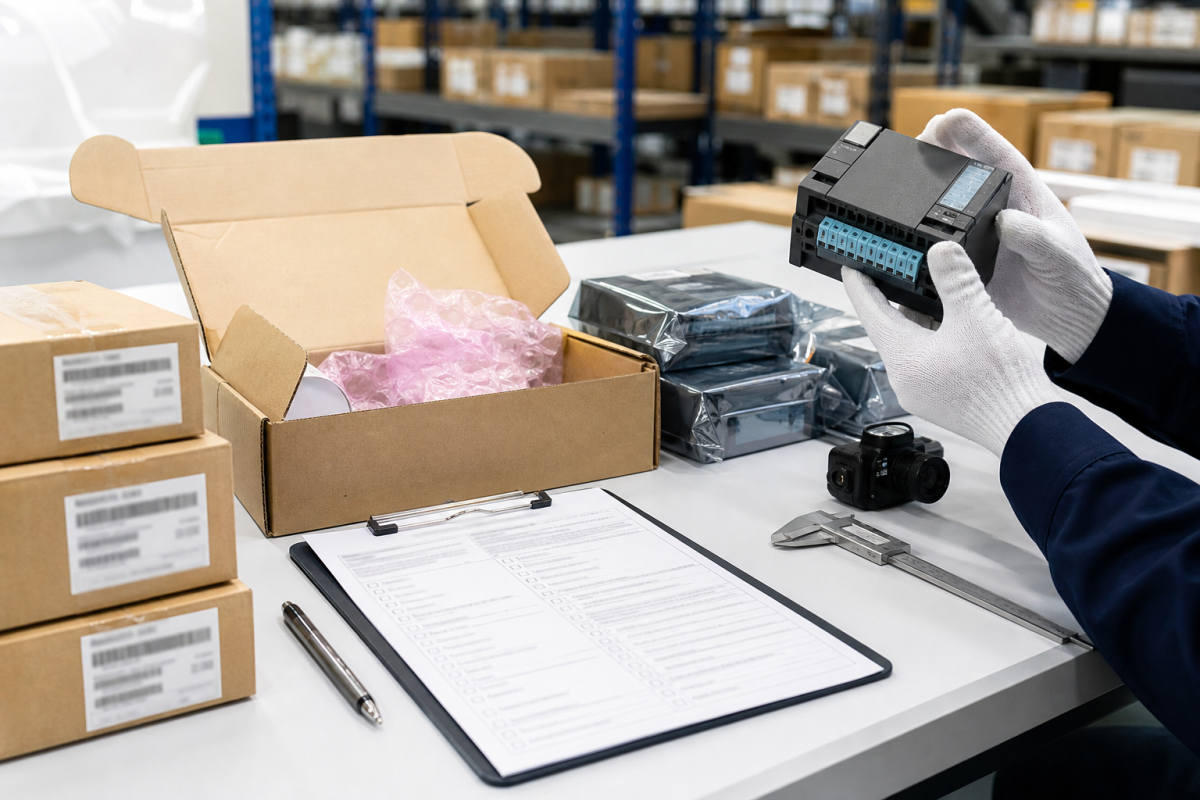
New surplus automation parts can look like the safest purchase: clean box, unused appearance, and a model number that matches the plant request. But old stock still needs inspection. Storage age, packaging condition, missing accessories, obsolete revisions, and unclear origin can all affect whether the item should be trusted as production recovery stock.
Konmask buyers should treat new surplus as a condition category, not a guarantee. The RFQ and receiving process should prove what is known, what is unknown, and what engineering still needs to approve.
Ask for packaging and label evidence before price
A useful RFQ includes photos of the outer box, inner packaging, module label, terminal cover, port area, seal condition, and included accessories. Do not rely on the phrase “new old stock” without visual evidence.
Start from Konmask’s industrial automation RFQ guide and add condition-specific questions: storage marks, opened packaging, accessory completeness, and whether actual-item photos are available.
If the plant needs an urgent spare, state whether a clean surplus item is acceptable or whether tested refurbished stock is preferred. The better option depends on the risk and available evidence.
Inspect the box like it belongs to the recovery plan
When the item arrives, check packaging damage, moisture signs, label match, revision, terminal covers, port condition, accessory count, and visible handling marks before it enters stores. A sealed box should still be documented with received photos.
If accessories are missing, label the item incomplete. A module without its terminal plug, connector, memory media, or mounting part may not be a field-ready spare.
For unclear cases, use the contact channel with photos and condition notes before approving repeat orders.
Do not confuse unused with approved
Unused does not automatically mean compatible. Revision, firmware family, power, port layout, and accessories can still make the item conditional.
Save accepted-match and rejected-match notes. If a surplus item is approved for one plant line, that evidence may help another buyer later. If it is rejected, the reason is equally valuable.
The receiving record should say whether the item is exact, conditional, bench-only, repair option, or rejected. This keeps stores honest when the next emergency arrives.
Procurement discipline that keeps the spare usable
A useful RFQ separates immediate replacement, planned shelf stock, repair exchange, test-bench hardware, and possible substitute. Those are not the same buying need. Immediate replacement needs dispatch certainty and accessory completeness. Planned stock can allow more time for condition comparison. Test hardware can be useful without being production-approved. A possible substitute needs engineering review before it is compared with an exact match.
Ask for actual photos, visible labels, port views, accessory scope, condition language, warranty terms, and realistic shipment timing. Compare device-only quotes against field-ready kits carefully. A low price becomes expensive when a missing connector, terminal plug, cable, memory card, power supply, mounting part, or configuration owner forces a second shipment during the maintenance window.
Receiving inspection should mirror the RFQ. Confirm model, revision, ports, power input, accessory count, packaging, visible condition, and included documents before the item enters stores. If firmware, software, backup, or approval status is unknown, mark it unknown. Clear uncertainty is safer than quiet confidence that surprises the next technician.
Risk ranking keeps the spare plan realistic. Not every component deserves the same shelf depth, but every critical component deserves a documented decision. Rank by downtime consequence, lead time, substitute confidence, backup complexity, accessory risk, local skill, and whether the plant can continue running while a replacement is sourced. This turns spare planning from opinion into a maintenance action that procurement can support.
Review the highest-risk records before each planned shutdown. Confirm the spare is still on the shelf, the accessory kit is still complete, the photos still match the installed equipment, and the named technical owner is still available. Quiet drift in stores is common; catching it before a work window is cheaper than discovering it during a night callout.
Make the record reusable
After the order, save the original RFQ photos, supplier photos, final quote, received-item photos, and engineering comments together. That file becomes the next buyer’s starting point. It also helps maintenance when the same platform appears in a later outage, shutdown, modernization review, or support discussion.
Use simple status labels: exact match, possible substitute, repair option, test bench only, rejected, or engineering review required. A conditional spare should not sit on the shelf pretending to be an exact replacement. Stores staff and night-shift technicians need the same clarity as the engineer who approved the quote.
Attach a decision owner to every uncertain item. The owner does not need to solve the whole lifecycle problem immediately, but someone should be named for compatibility review, backup validation, substitute approval, or receiving inspection. Anonymous uncertainty is what turns a normal spare request into an emergency meeting.
If the item is not ready for production use, say so directly on the record. Clear limits prevent a conditional spare from being pulled as if it were already approved.
FAQ
Is new surplus better than refurbished?
Not always. New surplus may be unused, but refurbished stock may have clearer testing evidence. The right choice depends on the application and documentation.
What photos should be requested?
Ask for box, label, module front, side label, ports, terminals, seal condition, accessories, and any visible storage or handling marks.
Should unopened packaging be opened for inspection?
That depends on plant policy, but receiving should at least document package condition and verify external labels before accepting it as ready stock.
Can Konmask help compare surplus offers?
Yes. Send photos, condition claims, accessory details, quantity, destination, and deadline so Konmask can help structure the RFQ.
Send Konmask your surplus offer photos and condition requirements before approval. Clear receiving evidence protects both price and recovery confidence.
© 2026 Konmask. All rights reserved. Official Website: https://www.konmask.com Inquiry: support@konmask.com | WhatsApp/Tel: +86 19859288691
