
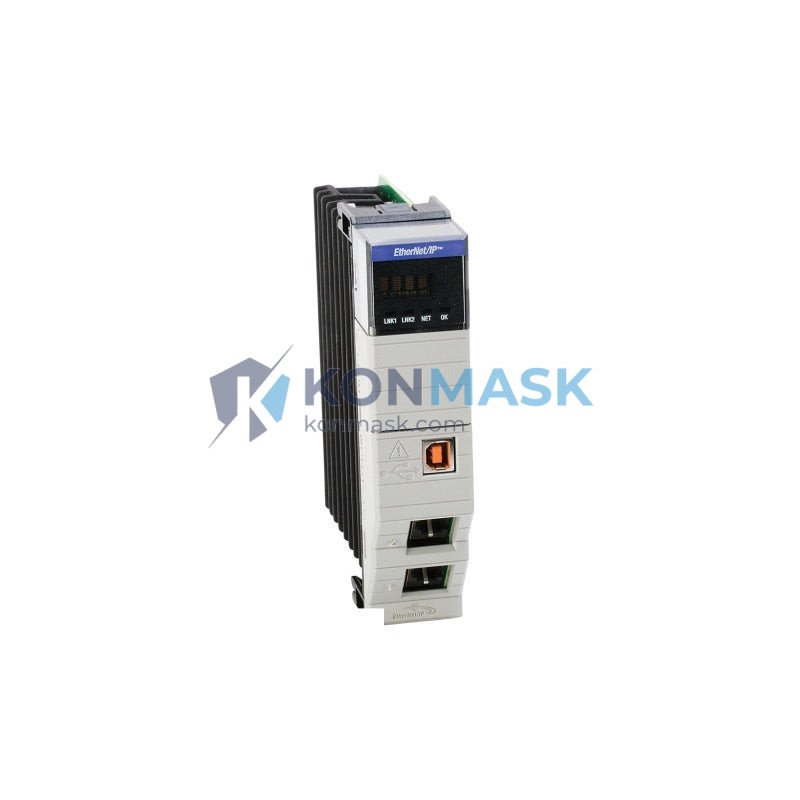
Allen-Bradley 1756-EN2TRK – ControlLogix EtherNet/IP 100Mbps Dual Ring (DLR) Communication Module | ControlLogix 1756 Platform
Engineering Background
The 1756-EN2TRK is a high-performance EtherNet/IP communication module designed for Allen-Bradley ControlLogix 1756 chassis. It delivers 100 Mbps full-duplex connectivity with native Device Level Ring (DLR) topology support, enabling fault-tolerant ring networks without an external managed switch. The CC (Conformal Coated) variant provides enhanced protection against moisture, dust, and corrosive atmospheres — making it the preferred choice for harsh industrial environments including chemical processing, offshore, and heavy manufacturing.
Product Positioning
Targeted at automation engineers who require deterministic, high-availability EtherNet/IP communication within ControlLogix-based control systems. The 1756-EN2TRK bridges the controller backplane to plant-floor EtherNet/IP networks, supporting both linear and DLR ring topologies with sub-3ms failover recovery — critical for continuous process and motion control applications.
Complete Technical Specifications
- Catalog Number: 1756-EN2TRK
- Manufacturer: Allen-Bradley / Rockwell Automation
- Series / Platform: ControlLogix 1756
- Network Protocol: EtherNet/IP (CIP over Ethernet)
- Data Rate: 100 Mbps Full-Duplex
- Topology Support: Linear, Star, Device Level Ring (DLR)
- DLR Ring Failover: < 3 ms
- Ethernet Ports: 2 × RJ-45 (10/100 Mbps auto-negotiate)
- CIP Connections: Up to 256 concurrent connections
- I/O Messaging: Unicast & Multicast
- Explicit Messaging: Supported (Class 3)
- Implicit Messaging: Supported (Class 1)
- Backplane Current Draw: 1.0 A @ 5 VDC; 3.0 mA @ 24 VDC
- Power Dissipation: 5.1 W (max)
- Operating Temperature: 0 °C to +60 °C
- Storage Temperature: -40 °C to +85 °C
- Relative Humidity: 5% to 95% (non-condensing)
- Conformal Coating: Yes (CC variant — IPC-A-610 Class 3)
- Vibration: IEC 60068-2-6
- Shock: IEC 60068-2-27
- Certifications: UL, CE, C-Tick, ATEX (Zone 2)
- Form Factor: Single-slot ControlLogix chassis module
- Weight: ~330 g
- Firmware: Field-upgradeable via ControlFLASH
Proven Application Environments
- Automotive assembly lines requiring high-speed I/O ring networks
- Chemical and petrochemical plants with corrosive atmosphere exposure
- Offshore oil & gas platforms (conformal coating for salt-air protection)
- Water/wastewater treatment facilities with high-humidity environments
- Food & beverage processing with washdown-adjacent control panels
- Power generation and utilities with redundant network requirements
- Mining and heavy industry with vibration and dust exposure
Engineering Advantages
- Native DLR Support: Eliminates the need for external managed switches in ring topologies, reducing BOM cost and network complexity.
- Sub-3ms Failover: Ensures process continuity during cable or node faults — critical for motion and safety-critical applications.
- 256 CIP Connections: High connection density supports large distributed I/O architectures within a single module.
- Conformal Coating (CC): IPC-A-610 Class 3 coating extends MTBF in harsh environments, reducing unplanned downtime.
- Dual-Port Architecture: Supports daisy-chain and ring wiring without additional hardware.
- ControlLogix Backplane Integration: Direct producer/consumer messaging with ControlLogix L7x/L8x controllers for deterministic data exchange.
System Architecture & Signal Flow
The 1756-EN2TRK occupies a single slot in the ControlLogix 1756 chassis and communicates with the controller via the high-speed backplane bus. On the network side, its two RJ-45 ports connect to EtherNet/IP devices (drives, I/O blocks, HMIs, safety modules) in linear or DLR ring configurations. In DLR mode, the module acts as a Ring Supervisor, continuously monitoring ring health and executing automatic failover in under 3 ms upon detecting a break. CIP I/O data is exchanged via implicit (Class 1) messaging at configurable RPI rates, while explicit (Class 3) messaging handles configuration and diagnostics. The module’s onboard web server provides real-time diagnostics accessible via standard browser — no additional software required.
Sourcing & Quality Verification
- All units sourced from authorized distributors or verified surplus channels with full traceability documentation.
- Each module undergoes incoming inspection: visual, label verification, firmware version check, and functional power-on test.
- Conformal coating integrity verified under UV inspection prior to shipment.
- Serialized units traceable to Rockwell Automation manufacturing records upon request.
- Packaging: ESD-safe anti-static bag + foam-lined carton; original Rockwell packaging preserved where available.
Procurement Process
- Submit your inquiry with required quantity and delivery timeline via support@konmask.com or the product page contact form.
- Receive a formal quotation with lead time, unit price, and shipping options within 24 business hours.
- Confirm purchase order — we accept T/T wire transfer, PayPal, and major credit cards.
- Order processed and dispatched within 1–3 business days; tracking number provided upon shipment.
- Post-delivery technical support available for integration and commissioning questions.
Technical FAQ
Q: What is the difference between 1756-EN2TR and 1756-EN2TRK?
A: The 1756-EN2TRK is the conformal coated (CC) version of the 1756-EN2TR. Functionally identical, the “K” suffix denotes IPC-A-610 Class 3 conformal coating for enhanced protection in harsh or corrosive environments.
Q: Can the 1756-EN2TRK act as a DLR Ring Supervisor?
A: Yes. The module supports both Ring Supervisor and Ring Node roles. Only one supervisor is required per DLR ring; all other nodes operate as ring participants.
Q: What ControlLogix controllers are compatible?
A: Compatible with all ControlLogix L6x, L7x, and L8x series controllers. Requires Studio 5000 Logix Designer v21.00 or later for full DLR configuration support.
Q: Is the firmware field-upgradeable?
A: Yes. Firmware updates are performed via Rockwell Automation’s ControlFLASH utility. Always verify firmware compatibility with your controller revision before updating.
Q: What is the maximum RPI (Requested Packet Interval)?
A: Minimum RPI is 1 ms; maximum is 3,200 ms. Typical motion and I/O applications use 2–10 ms RPI.
© 2026 Konmask.com. All rights reserved.
Original Source: https://Konmask.com
Contact: support@konmask.com | +0086 19859288691