
MITSUBISHI QJ71LP21S-25 – MELSECNET/H Optical Fiber Network Module | Q Series PLC Platform
Engineering Background
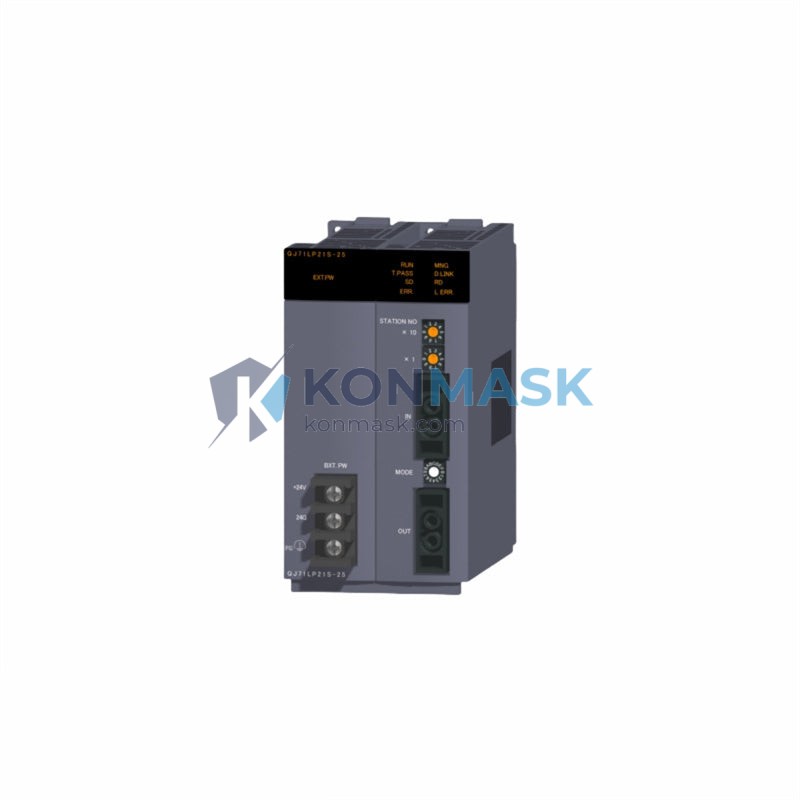
The QJ71LP21S-25 is Mitsubishi Electric’s dedicated MELSECNET/H optical fiber network module engineered for the MELSEC-Q Series programmable logic controller platform. Designed to meet the rigorous demands of large-scale distributed control architectures, this module enables high-speed, noise-immune data exchange across factory floors, process plants, and critical infrastructure environments where electromagnetic interference renders copper-based networks unreliable.
Product Positioning
As a control-station or normal-station network interface, the QJ71LP21S-25 serves as the backbone communication node in MELSECNET/H ring or bus topologies. It is the preferred choice for procurement engineers specifying redundant, deterministic industrial Ethernet alternatives in automotive assembly, semiconductor fabrication, water treatment, and power generation facilities.
Complete Technical Specifications
| Parameter | Specification |
|---|---|
| Part Number / SKU | QJ71LP21S-25 |
| Manufacturer | Mitsubishi Electric (三菱電機) |
| Series / Platform | MELSEC-Q Series |
| Network Standard | MELSECNET/H |
| Communication Speed | 25 Mbps |
| Transmission Medium | Optical Fiber (SI / GI compatible) |
| Topology | Ring / Bus |
| Station Type | Control Station / Normal Station |
| Max. Link Points (Bit) | 16384 points (LB) |
| Max. Link Points (Word) | 8192 points (LW) |
| Max. Stations per Network | 64 stations |
| Optical Connector | ST type (IN / OUT) |
| Power Consumption | 0.55 A (5 VDC internal bus) |
| Operating Temperature | 0 °C to 55 °C |
| Storage Temperature | -25 °C to 75 °C |
| Humidity | 5 % to 95 % RH (non-condensing) |
| Vibration Resistance | IEC 61131-2 compliant |
| Weight | Approx. 0.34 kg |
| Country of Origin | Japan |
| Applicable Base Unit | Q Series main base / extension base |
| Compatible CPU | Q02(H), Q06H, Q12H, Q25H, Q25PRH, QnPH series and above |
Proven Application Environments
- Automotive Manufacturing: Body-shop welding lines and paint-shop conveyor control requiring deterministic cycle times under 1 ms jitter.
- Semiconductor Fabrication: Clean-room process equipment networks where copper EMI would corrupt sensor data and trigger false alarms.
- Power Generation & Utilities: Substation automation and turbine control systems demanding galvanic isolation between high-voltage and control domains.
- Water & Wastewater Treatment: Multi-pump distributed control across large plant footprints exceeding copper distance limits.
- Food & Beverage Processing: Hygienic-area installations where optical fiber eliminates ground-loop interference from high-power motors.
- Petrochemical & Refining: Hazardous-area adjacent control rooms requiring intrinsically safe signal isolation.
Engineering Advantages
- Noise Immunity: Optical fiber transmission is completely immune to electromagnetic and radio-frequency interference — critical in high-voltage switchgear environments.
- Extended Distance: SI fiber supports up to 500 m per segment; GI fiber extends to 1 km, enabling plant-wide ring networks without repeaters.
- Deterministic Latency: MELSECNET/H token-passing protocol guarantees bounded cycle times, essential for synchronized motion and safety-critical interlocks.
- Redundant Ring Topology: Automatic loop-back on cable fault restores communication within one scan cycle — no manual intervention required.
- Seamless Q Series Integration: Plug-and-play with GX Works2 / GX Works3; network parameters configured via simple parameter editor without custom ladder code.
- High Link Capacity: 16 K bit + 8 K word shared link devices support complex multi-axis data exchange across all 64 stations simultaneously.
System Architecture & Signal Flow
In a typical MELSECNET/H ring configuration, the QJ71LP21S-25 installed in the control station CPU rack acts as the network master. It cyclically broadcasts link device data (LB/LW) to all normal stations at 25 Mbps. Each normal station — also equipped with a QJ71LP21S-25 — refreshes its local I/O and returns updated data within the same token-passing cycle. The optical ring provides a redundant return path; if the primary fiber is severed, the module automatically switches to the backup path and raises a diagnostic flag in GX Works without halting production.
Transient data (message communication) is handled via dedicated link registers, allowing peer-to-peer reads/writes between any two stations without burdening the cyclic refresh bandwidth.
Sourcing & Quality Verification
- OEM Authenticity: All units sourced through verified Mitsubishi Electric authorized distribution channels or directly from certified industrial surplus with full traceability documentation.
- Pre-shipment Inspection: Each QJ71LP21S-25 undergoes visual inspection (label integrity, connector condition, PCB cleanliness), power-on self-test verification, and optical loopback communication test before dispatch.
- Counterfeit Prevention: Serial numbers cross-referenced against Mitsubishi Electric’s product database. Units with tampered labels, mismatched firmware revisions, or non-OEM optical connectors are rejected.
- Packaging: Anti-static bag + foam-lined carton with desiccant; compliant with IEC 60068-2 transport vibration requirements.
Procurement Process
- Confirm Compatibility: Verify your Q Series CPU model and base unit slot count. Contact our engineering team if you need a compatibility matrix for your specific system configuration.
- Request a Quote: Submit your RFQ via the product page or email support@konmask.com with quantity, required delivery date, and destination port.
- Order Confirmation: We issue a proforma invoice with lead time, Incoterms, and HS code (8537.10) within 24 business hours.
- Quality Documentation: Certificate of conformance, test report, and packing list provided with every shipment. CNAS-accredited inspection reports available on request.
- Logistics: DHL Express / FedEx International Priority standard; sea freight LCL/FCL available for bulk orders. Export license compliance handled by Konmask for all destinations.
Technical FAQ
Q: Can the QJ71LP21S-25 operate as both control station and normal station?
A: Yes. The station type is set via GX Works parameter editor — no hardware modification required. One module per network must be designated as control station.
Q: Is the QJ71LP21S-25 compatible with MELSECNET/10 networks?
A: No. MELSECNET/H and MELSECNET/10 are separate network standards. The QJ71LP21S-25 is MELSECNET/H only. For MELSECNET/10 compatibility, refer to the QJ71LP21 (without the “-25” suffix).
Q: What fiber type is required — SI or GI?
A: The “S” in QJ71LP21S-25 denotes SI (Step-Index) plastic optical fiber. GI (Graded-Index) glass fiber modules carry a different suffix. Ensure your fiber plant matches the module type before ordering.
Q: What is the maximum cable length per segment?
A: For SI plastic fiber: 30 m (standard) up to 500 m depending on fiber grade. Consult the MELSECNET/H Network System Reference Manual (SH-080124) for detailed distance tables by fiber specification.
Q: Can I mix QJ71LP21S-25 with older A-Series MELSECNET/H modules?
A: Mixed-generation networks require careful firmware and parameter alignment. Contact Konmask’s engineering team for a compatibility assessment before committing to a mixed architecture.
Q: What programming software is required?
A: GX Works2 (version 1.40S or later) or GX Works3. GX Developer is not recommended for new Q Series MELSECNET/H configurations.
© 2026 Konmask.com. All rights reserved.
Original Source: https://Konmask.com
Contact: support@konmask.com | +0086 19859288691