

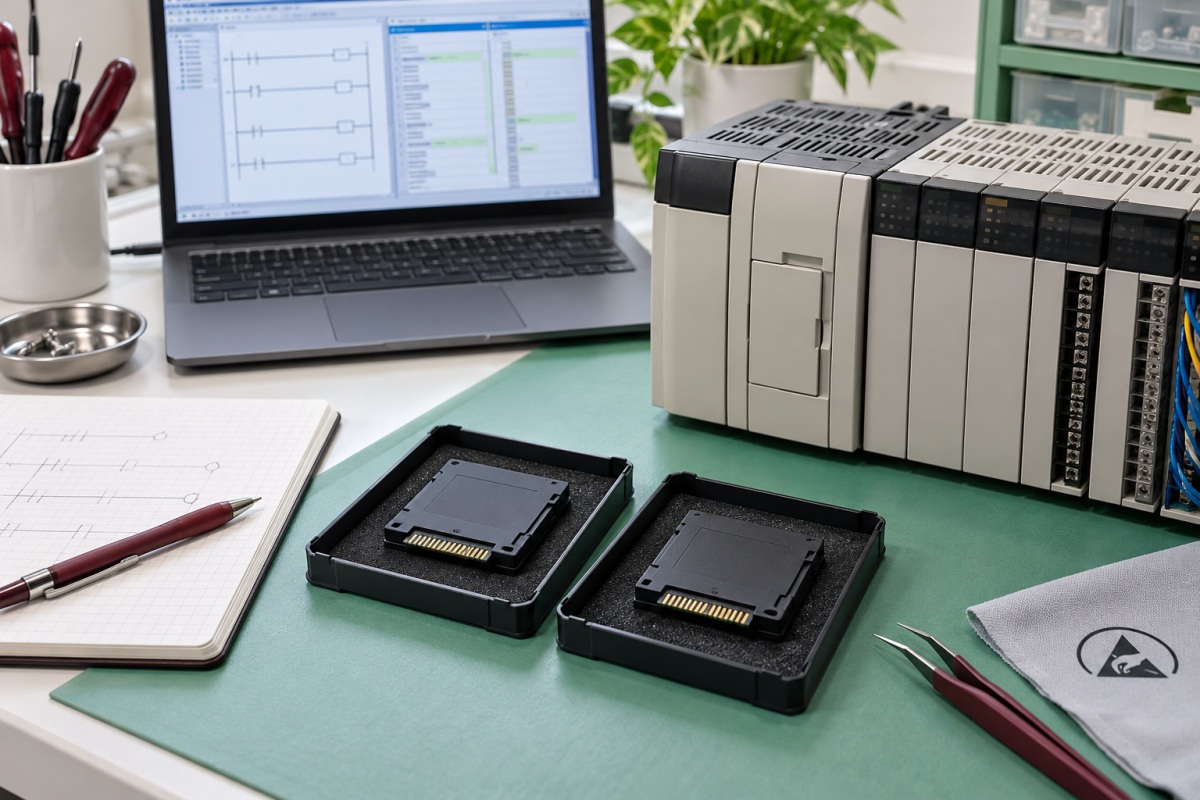
A memory cassette in a locked drawer can create a false sense of security. It may be the correct family, physically undamaged and carefully labeled, yet contain an obsolete machine program. It may also hold only the data areas defined by the controller, rather than everything an operator expects to recover. The question is not simply whether the factory owns a cassette. It is whether that cassette is part of a proven recovery arrangement.
For an Omron CQM1 installation, separate three purchasing decisions: the cassette hardware, its saved contents and the CPU on which those contents will be used. Combining them into one line called backup memory hides the acceptance criteria for all three.
What the capacity label does and does not tell you
Omron’s CQM1 programming manual identifies CQM1-ME04K as a 4K-word EEPROM cassette and CQM1-ME08K as an 8K-word version, both without a clock. It describes a transfer set including the user program, PC Setup, fixed DM and expansion instruction information. That defined set is not a promise to preserve every changing production value.
The manual also distinguishes cassette capacity from usable program size in a particular CPU configuration. Therefore, a buyer should not convert a capacity label directly into a guaranteed fit for the installed application. Obtain the exact CPU identity and the engineering team’s confirmed recovery requirement before choosing the cassette.
Konmask’s CQM1-ME04K and CQM1-ME08K memory cassette listing is a place to start an exact-model inquiry, not evidence that the two capacities are interchangeable for every project. State the requested variant clearly and ask the supplier to identify the offered item. A combined catalog title should never become an ambiguous purchase order.
A spare cassette is not a machine program
Unless expressly included and authorized, assume the hardware quotation does not include the plant’s application. A supplier cannot reconstruct a proprietary process from the cassette part number. The owner of the machine program must provide the controlled recovery image and determine whether it matches the current approved machine state.
Use a recovery record that connects the machine identifier, CPU reference, project revision, backup date and verification result. Record who approved the image and what changed after it was taken. A date written on a storage box is useful, but it does not establish that the program inside corresponds to the latest accepted modification.
For example, a packaging line may have received a sensor change after the last cassette was prepared. Restoring an older image could recreate the previous logic even though the hardware replacement is perfect. This is a hypothetical planning example, not a reported customer incident. It shows why configuration ownership belongs beside hardware ownership in the spare register.
Control the startup behavior
The CQM1 operation manual explains automatic cassette-to-CPU transfer at startup under the relevant DIP-switch setting. It also requires power to be turned off before cassette installation or removal. These details make a cassette more than passive storage: an approved setting can determine what program is loaded at restart.
Do not change that setting casually to see whether a problem disappears. The responsible engineer should follow the exact CPU manual and the plant’s controlled recovery procedure. Preserve existing evidence before any overwrite, keep machinery safely isolated and obtain authorization for the intended program state. This article is not a switch-setting or live restoration procedure.
When a CPU replacement is also being considered, treat the CQM1-CPU43-V1 catalog reference as a separate identity check. Read the complete installed and offered nameplates, including regional and version markings. Do not assume a shortened web title proves an exact CPU match or establishes that a particular cassette image is suitable.
Make the verification result useful to the next shift
A recovery exercise should answer a small number of concrete questions. Can the authorized team access the project and required tools? Is the saved image identified? Can the defined data set be compared or restored using the approved method? Does the resulting configuration meet the machine’s acceptance criteria? Which operating values need a separate controlled restoration route?
Record the scope honestly. A successful file comparison does not prove the complete machine cycle. A bench exercise does not prove field wiring or process behavior. A supervised machine test may still exclude certain operating modes. Clear limitations are more valuable than an unexplained passed stamp because they show the next engineer what remains to be checked.
Keep at least one controlled copy outside the individual cassette’s storage location under the plant’s information-management rules. This is a resilience measure, not an invitation to distribute licensed software or sensitive machine programs. Access, revision control and ownership should remain explicit. Purchasing should request hardware evidence, not casually email the entire application to every bidder.
For receiving inspection, separate physical acceptance from recovery acceptance. Check the requested model, visible condition and supplier scope first. Then route the item to the approved technical process. A blank cassette can be correctly supplied hardware while still being unready for issue as a recovery spare.
Practical questions
Will a larger cassette automatically solve our backup problem?
No. Capacity is only one constraint. The CPU variant, supported transfer contents and approved application image must also match. A larger blank device does not make an outdated backup current.
Does a cassette preserve every production setting?
Do not assume so. Identify the data areas covered by the exact controller’s transfer function, then separately document any recipes, operating values or external device settings needed for recovery.
Can a supplier include the machine program?
Only where that is explicitly scoped, technically verified and legally authorized. Ordinary spare hardware supply should not be interpreted as supplying the plant’s current application or commissioning service.
What should be written on the stock record?
Record the exact cassette and CPU references, machine identity, approved image revision, verification date, restrictions and responsible owner. Distinguish blank hardware from a prepared, technically released recovery spare.
Contact support@konmask.com with the exact cassette variant, CPU label photographs, quantity and required condition. Konmask can clarify the hardware offer while your authorized engineering team retains control of the machine program and restoration approval.
Image: AI-generated editorial illustration, not an exact product photograph or installation reference.
© 2026 Konmask. All rights reserved. Official Website: https://www.konmask.com Inquiry: support@konmask.com | WhatsApp/Tel: +86 19859288691
