
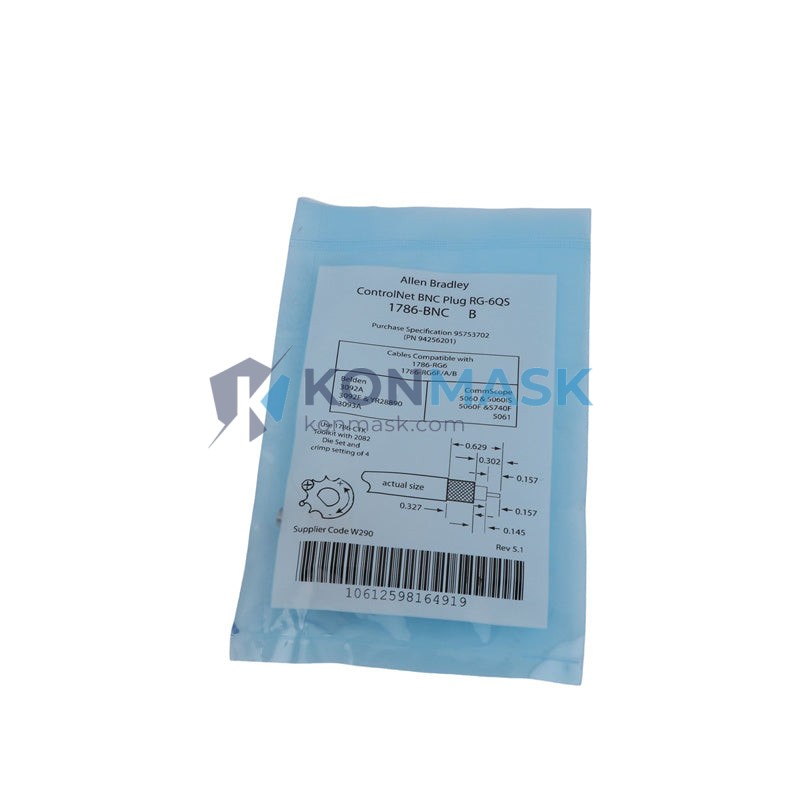
Allen-Bradley 1786-XT — ControlNet Network Terminating Resistor | ControlNet Platform
Engineering Background
ControlNet is a deterministic, repeatable media-access network developed by Rockwell Automation for time-critical I/O and peer-to-peer messaging. Proper bus termination is a mandatory physical-layer requirement: without correctly placed terminating resistors at both cable ends, signal reflections degrade network integrity, increase CRC error rates, and can cause intermittent node dropouts or full network faults. The 1786-XT is the factory-specified terminator for all ControlNet coaxial trunk segments.
Product Positioning
The Allen-Bradley 1786-XT is a passive BNC-terminated resistor assembly designed to absorb signal energy at each physical end of a ControlNet trunk cable. It is a mandatory installation component — not optional — for every ControlNet segment, and must be present at both the first and last node on the trunk. Konmask.com supplies genuine Allen-Bradley 1786-XT units sourced through verified industrial distribution channels, suitable for new installations, spares inventory, and field replacements.
Complete Technical Specifications
- Part Number: 1786-XT
- Manufacturer: Allen-Bradley / Rockwell Automation
- Network Platform: ControlNet (IEC 61158 Type 2)
- Function: Coaxial trunk bus termination
- Connector Type: BNC male plug
- Termination Impedance: 75 Ω (matched to ControlNet RG-6 coaxial cable characteristic impedance)
- Installation Quantity per Segment: 2 (one at each physical end of the trunk)
- Compatible Cable: 1786-RG6 (RG-6 coaxial trunk cable)
- Compatible Taps: 1786-TPR, 1786-TPS, 1786-TPYR, 1786-TPYS series
- Operating Temperature: 0 °C to +60 °C (32 °F to 140 °F)
- Storage Temperature: −40 °C to +85 °C
- Enclosure Rating: Open-style (install inside enclosure or protected environment)
- Approvals: UL Listed, CE Marked (as part of ControlNet system)
- Weight: Approx. 80 g
- Catalog Series: 1786 ControlNet Media
Proven Application Environments
- Automotive Manufacturing: Body-in-white welding lines and paint shop conveyors using ControlLogix with ControlNet I/O drops
- Oil & Gas: Wellhead and pipeline SCADA panels with SIL-rated ControlNet segments
- Food & Beverage: High-washdown production lines where ControlNet provides deterministic I/O scan times
- Water/Wastewater Treatment: Multi-drop ControlNet segments spanning pump stations and clarifier drives
- Power Generation: Turbine control panels requiring deterministic network timing
- Discrete Manufacturing: Any ControlLogix, PLC-5, or SLC 500 system with a ControlNet scanner card (1756-CNB, 1747-SCNR, 1771-ACN15)
Engineering Advantages
- Mandatory Compliance: Satisfies Rockwell Automation ControlNet physical-layer installation requirements — no workarounds exist for missing terminators
- Signal Integrity: 75 Ω matched termination eliminates standing waves and reflection-induced bit errors on the coaxial trunk
- Plug-and-Install: BNC male connector mates directly to 1786-series taps and media couplers — no tools, no crimping
- Compact Form Factor: Minimal footprint; fits inside standard DIN-rail enclosures alongside tap assemblies
- Long Service Life: Passive resistive component with no active electronics — MTBF effectively unlimited under normal operating conditions
- Genuine OEM Part: Ensures compatibility with Rockwell Automation network diagnostics (RSNetWorx for ControlNet) and warranty compliance
System Architecture & Signal Flow
A ControlNet trunk segment is a daisy-chained coaxial bus. Nodes connect via taps (1786-TPR/TPS) teed off the trunk. The trunk must be terminated at both physical ends to prevent signal reflections:
- Trunk Cable: 1786-RG6 coaxial cable (75 Ω characteristic impedance)
- Node Taps: 1786-TPR (repeating) or 1786-TPS (non-repeating) — connect scanner cards and I/O adapters
- Terminator Placement: 1786-XT installed at the BNC port of the first and last tap on each trunk segment
- Repeaters: 1786-RPCD or 1786-RPFRL extend segments beyond 1,000 m; each new segment requires its own pair of 1786-XT terminators
- Network Scheduling: RSNetWorx for ControlNet configures NUT (Network Update Time) and scheduled/unscheduled bandwidth — proper termination is a prerequisite for stable scheduling
Sourcing & Quality Verification
- Origin: Genuine Allen-Bradley / Rockwell Automation production stock
- Supply Chain: Sourced through verified industrial automation distributors; no gray-market or counterfeit exposure
- Inspection: Each unit inspected for BNC connector integrity, labeling accuracy, and packaging condition prior to dispatch
- Documentation: Certificate of conformance available on request; original manufacturer packaging preserved where possible
- Traceability: Lot and date codes recorded for quality audit purposes
Procurement Process
- Step 1 — Inquiry: Submit your BOM or part number to support@konmask.com or via the product page quote form
- Step 2 — Stock Confirmation: Konmask confirms availability and lead time within 1 business day
- Step 3 — Quotation: Formal quotation issued with unit price, shipping cost, and estimated delivery
- Step 4 — Order Placement: Purchase order or online checkout accepted; T/T, PayPal, and credit card supported
- Step 5 — Dispatch & Tracking: Ships within 1–3 business days; tracking number provided via email
- Step 6 — After-Sales: 30-day return policy for unused, unopened items; technical support available post-installation
Technical FAQ
Q: How many 1786-XT terminators does a single ControlNet segment require?
A: Exactly two — one at each physical end of the trunk cable. Installing only one, or none, will cause network faults and unpredictable node behavior.
Q: Can I use a generic 75 Ω BNC terminator instead of the 1786-XT?
A: Technically the impedance value is the same, but Rockwell Automation specifies the 1786-XT for warranty and certification compliance. Generic terminators may not meet the mechanical retention or environmental specifications of the 1786 media system.
Q: Is the 1786-XT compatible with ControlNet fiber segments?
A: No. Fiber ControlNet segments (1786-RPFRL repeater links) use optical termination inherent to the fiber connectors. The 1786-XT is for coaxial trunk segments only.
Q: What happens if a terminator fails or is accidentally removed?
A: The network will experience signal reflections. RSNetWorx diagnostics will typically report increased error counts or node timeouts. Replace the 1786-XT immediately and re-verify network health.
Q: Does Konmask offer quantity pricing for MRO or project orders?
A: Yes. Contact support@konmask.com with your required quantity for a volume discount quotation.
Q: What is the lead time for the 1786-XT?
A: In-stock units ship within 1–3 business days. For larger quantities, lead time is confirmed at quotation stage.
© 2026 Konmask.com. All rights reserved.
Original Source: https://Konmask.com
Contact: support@konmask.com | +0086 19859288691