

The June 2026 CISA advisory for Rockwell Automation FLEX I/O EtherNet/IP adapters gives buyers a practical reason to clean up their remote I/O spare lists. The advisory is a cybersecurity document, but the procurement lesson is simple: if a plant needs to patch, isolate, replace, or recover a remote I/O adapter, the RFQ must identify more than the word “adapter.”
Konmask sees this problem often. A buyer sends one photo of a cabinet or a partial model number. The sourcing team can recognize the family, but the final spare may depend on the exact adapter, terminal base, power supply, I/O module stack, series, and condition requirement. FLEX I/O is modular by design, which is useful for maintenance, but it also means an incomplete RFQ can lead to a correct-looking part that does not solve the shutdown problem.
Start with the installed module stack
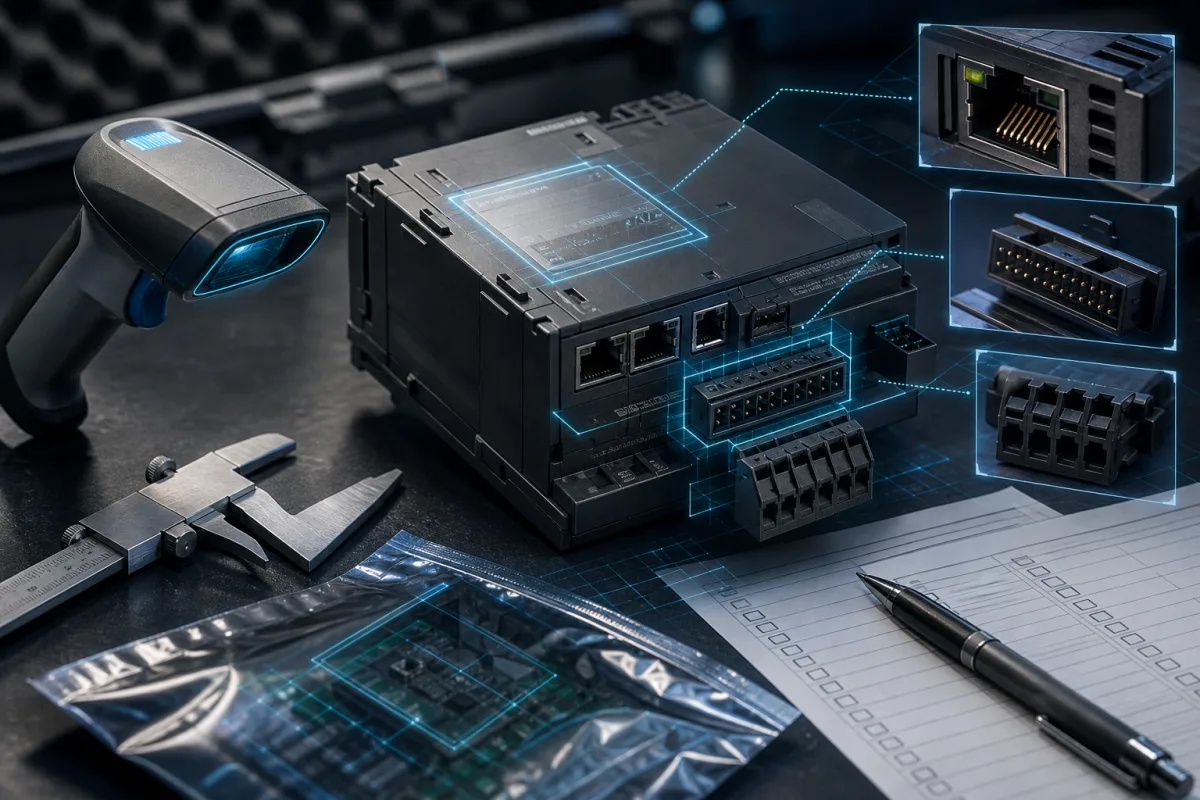
For Allen-Bradley 1794-style remote I/O, do not treat the adapter as a stand-alone purchase until the cabinet has been checked. Photograph the adapter label, the full module stack, the terminal base part numbers, the power supply, and the wiring side. A replacement adapter may be the urgent item, but a damaged or incompatible terminal base can delay the recovery just as much.
For example, buyers checking FLEX I/O shelves may need to distinguish between an adapter, a terminal base such as an Allen-Bradley 1794-TB3K Flex I/O terminal base unit, and a related power item such as an Allen-Bradley 1794-PS13 FLEX I/O power supply module. These are different spare decisions, even though they may sit side by side in the same remote I/O assembly.
What the advisory changes for purchasing
A security advisory can increase urgency. Maintenance may suddenly ask purchasing to find spares before a network segmentation change or firmware window. That is the moment when incomplete information becomes expensive. If the RFQ does not include series, revision, condition expectation, and delivery deadline, suppliers must ask follow-up questions while the outage date moves closer.
Buyers should also confirm whether the spare is for immediate replacement, preventive stock, or test-bench validation. Emergency replacement requires fastest compatible availability. Preventive stock may allow more time to compare factory sealed, new surplus, or tested used options. Test-bench validation may need a broader kit, including a base, power supply, and sample I/O module.
Another practical issue is packaging. Remote I/O modules and terminal bases can be damaged by poor handling, bent pins, or dirty connector areas. Ask for clear photos before shipment where possible, and specify anti-static packing for electronic modules. If the part is needed for a shutdown, the receiving team should know exactly what visual checks to perform when it arrives.
A better RFQ format
A strong FLEX I/O RFQ should include the exact catalog number, series or revision, quantity, full label photo, module stack photo, terminal base photo, required condition, destination country, and deadline. If your site accepts compatible alternatives, say what can vary and what cannot. If the plant requires an exact installed match, state that clearly.
Do not wait until the maintenance window to check whether the cabinet contains accessories that are not on the spare list. A short cabinet photo review can reveal missing power supplies, removable terminal blocks, or base units that should be sourced together. This is especially important for plants supporting multiple Rockwell families, where ControlLogix, CompactLogix, and FLEX I/O spares may be mixed in the same storage room.
Konmask’s News & Insights section focuses on these buying details because correct identification is often the difference between a fast recovery and another round of urgent emails.
For stocked items, also ask for the evidence that matches your risk level. Preventive stock may only need clear photos and condition confirmation. A shutdown-critical order may need pre-shipment testing notes, packing photos, and confirmation that accessories shown in the quote are included. If you are buying several Allen-Bradley 1794 items together, ask the supplier to line up the quote by installed position: adapter, terminal base, I/O slice, power module, and any accessory. That makes it easier for the receiving team to check the shipment against the cabinet before the maintenance window starts.
Do not let price comparison hide configuration differences. One offer may include only the module. Another may include a terminal base. A third may be tested used rather than new surplus. All three can look similar in a spreadsheet, but they do not carry the same recovery value. A buyer who records these differences in the RFQ saves engineering from approving the wrong item under pressure.
FAQ
Can I quote a FLEX I/O spare from only one cabinet photo?
Sometimes, but it is risky. A full stack photo plus close-ups of the label, terminal base, and power supply gives the sourcing team much better evidence.
Should I buy the adapter and terminal base together?
If the shutdown risk is high, it is worth checking both. The adapter may be the advisory focus, but a base or connector issue can still prevent installation.
What condition should I request?
State whether you need factory sealed, new surplus, refurbished, or tested used. If the part is for emergency stock, tested availability and delivery time may matter as much as condition.
What if the exact part is hard to find?
Ask the supplier to separate exact-match options from possible alternatives. Do not approve a substitute until engineering confirms compatibility with the installed system.
Send Konmask your FLEX I/O photos, model numbers, quantity, required condition, and destination. We can help check the RFQ before you commit to a part that looks right but misses a critical detail.
© 2026 Konmask. All rights reserved. Official Website: https://www.konmask.com Inquiry: support@konmask.com | WhatsApp/Tel: +86 19859288691
