

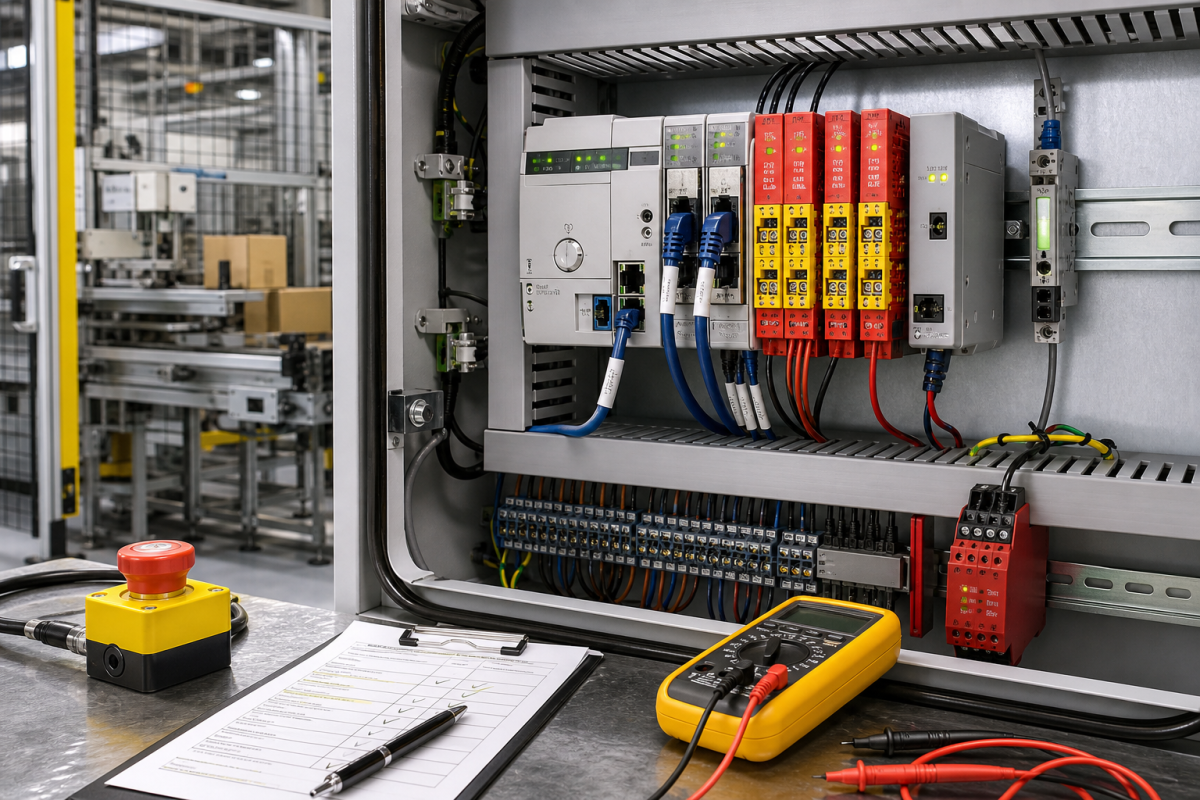
A safety PLC spare is not accepted when it powers up. It is accepted when the machine safety function is restored, the safety signature or validation evidence is controlled, and the plant can prove the stop circuits, interlocks, and reset behavior are still correct.
Konmask readers are often under pressure to recover a packaging line, robot cell, press, conveyor, or guarded machine quickly. For Compact GuardLogix systems, procurement speed helps only if the controller identity, firmware, project, safety I/O, network path, and validation plan are known before the shutdown window.
Treat The Controller As A Safety Asset
Record controller model, series, firmware, safety task, standard task, project version, safety signature if used, Ethernet topology, I/O list, power, memory, panel position, guarded equipment, and the consequence of a failed validation.
The live Allen-Bradley 1769-L30ERMS Compact GuardLogix reference is a product match for the controller side of the RFQ. Compare firmware, memory, safety project, network, and installed role before approval.
Photograph controller labels, safety I/O, power supply, network cables, E-stop circuits, guarded machine, cabinet terminals, HMI safety alarms, and the engineering workstation backup status.
Do Not Hide The I/O Dependency
A controller replacement can fail validation because an output module, terminal base, field device, network adapter, or reset circuit was not included in the spare scope. Safety recovery is a system event, not a CPU-only event.
The related Allen-Bradley 1771-OBN digital output module reference is not the same platform, and that is exactly the lesson: legacy output hardware must be identified separately when mixed cabinets and older machines share one maintenance window.
Ask for exact controller, tested exchange, refurbished, and substitute options separately. Each option needs its own firmware, project restore, safety validation, warranty, and commissioning statement.
Validation Is The Real Deadline
After replacement, verify controller identity, firmware, project download, safety status, I/O states, network connections, E-stop behavior, gate switches, reset logic, alarms, fault recovery, and the approved validation checklist.
If a replacement requires firmware change or project conversion, record it as an engineering change. A quick download is not the same as a validated safety function.
Store the spare record with the project backup, validation owner, I/O list, network drawing, photos, and final machine-safety approval.
Prepare The RFQ Around Approval Evidence
Send controller labels, firmware, project status, safety signature information, I/O and cabinet photos, guarded machine function, required condition, test scope, and validation date.
Ask whether the supplied controller is ready for project restore or needs firmware handling before commissioning. That question can decide whether the outage is hours or another shift.
For urgent orders, separate commercial availability from safety acceptance. A stocked controller still needs the right project and a competent safety approver before the line is released.
Keep direct replacement, repair exchange, refurbished stock, substitute, and migration candidate as separate commercial lines. They carry different approval work, and mixing them under one compatible description hides the real maintenance risk.
The most useful RFQ evidence is practical: actual label photos, cabinet context, connector views, wiring markers, firmware or configuration status, required condition, test expectation, accessory scope, delivery deadline, and the name of the person who can approve a technical exception.
Receiving inspection should repeat the same identity checks used during selection. Photograph the actual received unit, compare terminals and connectors, review test evidence, record packaging condition, and mark any unresolved compatibility question before the item goes into stores.
A spare is ready only when the plant can install it, restore the needed data, test the function, and roll back if the replacement exposes a second problem. Procurement can buy the item; engineering evidence makes it recoverable.
The fastest teams do this before the failure. They keep a light asset sheet for each critical cabinet, update it during routine inspections, and attach photographs from the actual installation. When a failure happens, the buyer can send a serious RFQ in minutes instead of asking maintenance to reopen a hot panel.
Revision control also deserves attention. Two modules with the same family name may differ by firmware, option board, communication behavior, power requirement, connector style, environmental rating, or configuration tool. The quote should surface those differences rather than turning them into surprises during installation.
For multi-site companies, the same model may not mean the same risk. One plant may use the item in a noncritical monitoring role, while another uses it for trip logic, permissive control, machine protection, or an environmental permit signal. Rank spare urgency by installed consequence, not by purchase price alone.
Finally, avoid treating obsolete automation as a single emergency category. Some parts are good direct-spare candidates; others should be repaired, refurbished, tested as exchange units, or migrated at the next planned shutdown. A clear record lets the plant choose deliberately instead of reacting to the first available listing.
Good handover notes matter as much as the purchase order. If the night shift, reliability team, controls engineer, and buyer describe the same spare in different language, the plant can lose hours reconciling facts that should have been captured once.
FAQ
What must match on a Compact GuardLogix spare?
Match controller model, series, firmware, project, safety task, memory, Ethernet role, I/O dependencies, and validation method.
Can a standard CompactLogix replace it?
No. Safety-rated controller functions, project structure, safety signature, and validation requirements must be reviewed.
What should procurement send?
Send labels, firmware, project status, cabinet and safety I/O photos, machine function, test scope, and validation deadline.
What proves safety recovery?
Correct project restore, healthy safety status, verified I/O, correct E-stop and guard behavior, alarms, reset logic, and signed validation.
Send Konmask the controller labels, safety I/O photos, firmware and project status, guarded machine function, condition requirement, and validation deadline. We can help prepare a controlled safety PLC RFQ.
© 2026 Konmask. All rights reserved. Official Website: https://www.konmask.com Inquiry: support@konmask.com | WhatsApp/Tel: +86 19859288691
