

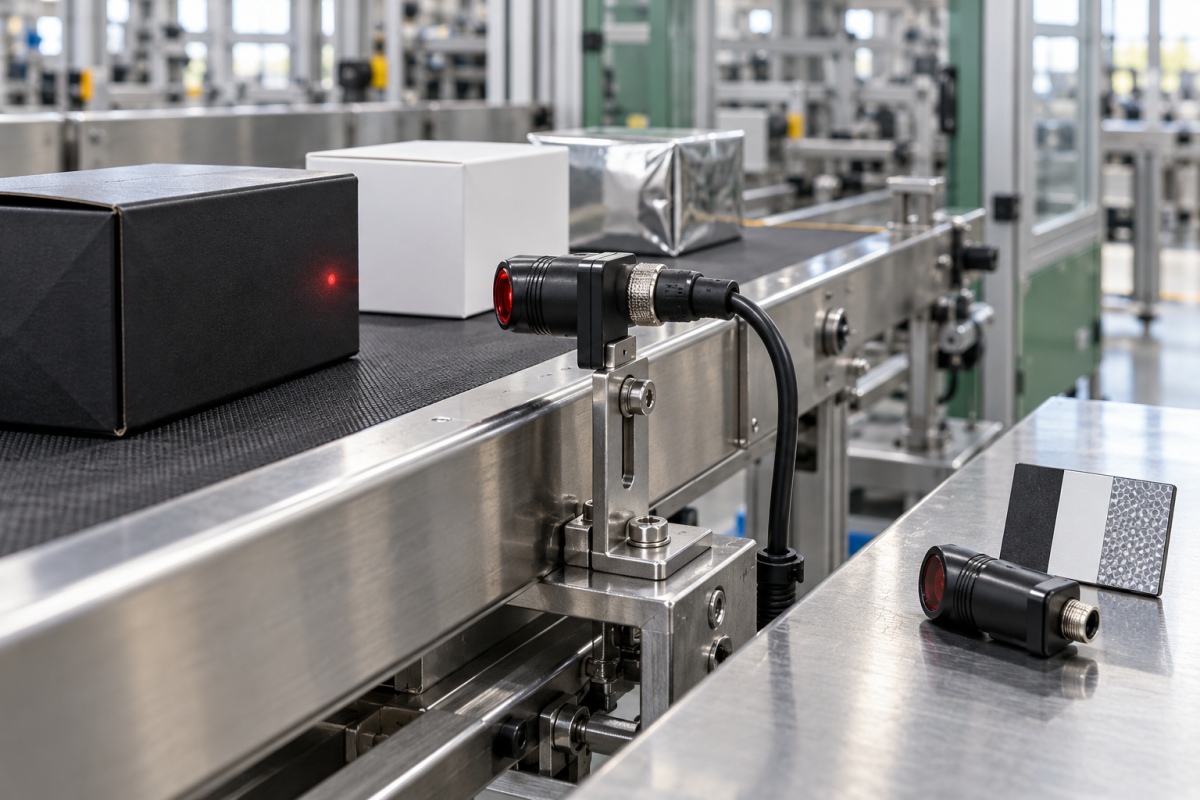
A sensor detects the white sample carton perfectly during inspection, yet misses a dark package on the production line. The immediate argument is often whether the delivered sensor is faulty. A better question comes earlier: did the purchase specification describe the objects the sensor actually needed to detect?
For diffuse-reflective photoelectric sensors, the target is part of the application. Buying by nominal range and thread size alone leaves important acceptance criteria undefined. The Omron E3RA-DP22 provides a useful example of how maintenance and procurement can turn a short model request into a testable supply requirement without creating an unnecessarily complicated document.
First establish exactly which sensor is being requested
Omron’s E3RA product lineup lists E3RA-DP22 as a diffuse-reflective, PNP-output model with an M12 connector and a nominal 300 mm sensing distance. Neighboring codes cover other distances, outputs and sensing methods. A similar-looking housing is therefore not enough to establish the replacement.
The family specification tables provide the applicable operating and sensing conditions. Use those conditions when interpreting range; do not turn a catalog distance into an unconditional promise for every package surface. Also distinguish a sensor’s electrical output selection from the PLC’s logic interpretation of object present or absent.
When requesting the Omron E3RA-DP22 photoelectric sensor, include a clear view of the complete installed code and connector. This provides a concrete catalog reference while leaving condition, availability and suitability subject to the actual quotation and application review.
Make the acceptance sample representative
A procurement sample should represent a difficult but legitimate production condition, not merely the easiest object to demonstrate. For a packaging conveyor, identify the darkest surface, the most reflective finish, the smallest relevant target area and the largest permitted position variation. If different product families use the same station, include the range that station is expected to handle.
Consider a hypothetical line that runs both plain white cartons and black printed cartons. A test using only the white carton establishes performance for that test arrangement. It does not prove the black carton will provide the same reflected-light margin. The useful receiving record identifies the tested sample, distance and orientation so engineering can decide what additional line validation is necessary.
Avoid accepting vague statements such as “tested with an object.” Ask for photographs or identifiers of the actual target and mounting arrangement. Keep the evidence proportionate: a small controlled sample set is often more useful than a long certificate that never defines what passed in front of the sensor.
Separate device acceptance from application acceptance
Device acceptance addresses identity, visible condition, connector integrity and the functions within an agreed test scope. Application acceptance addresses whether the installed station detects the required objects under approved operating conditions. Combining these into a single pass box makes troubleshooting a commercial disagreement instead of an engineering exercise.
The boundary matters when a replacement is proposed because the exact model is unavailable. A substitute may operate correctly as a sensor but behave differently with the existing mounting angle, background or target finish. Agree who will authorize the alternative and what sample testing must occur before shipment or installation. Do not describe a proposed substitute as approved merely because it fits the bracket.
Keep the output and connection checks equally explicit. Record the required PNP arrangement, supply requirements, connector pin assignment from the applicable documentation, and the destination input circuit. A connector that physically mates does not prove the cable or input arrangement is correct. Wiring work belongs to qualified personnel following the machine documentation.
Mounting details belong in the RFQ
A narrow bracket, nearby guide rail or flexible cable route can make a nominally suitable device difficult to fit. Photograph the sensor from the front and side, show its relationship to the object path, and note the permitted mounting envelope. Include whether the cable, mounting nuts or bracket are required supply items rather than assuming they accompany the sensor.
Record the background behind the target and the closest surrounding reflective surfaces. This is not an invitation to specify improvised optical fixes; it gives the application engineer enough context to judge whether a like-for-like sensor remains appropriate. If the production setup has changed since the original installation, a replacement purchase may expose an application change rather than a defective spare.
Document cleaning conditions and relevant environmental requirements using the manufacturer’s ratings and site rules. Do not infer chemical compatibility from an enclosure protection code alone. If washdown agents, protective covers or mounting changes are involved, obtain explicit confirmation for those conditions.
Use a short, measurable release record
A practical record has five parts: the delivered identity, the samples used, the physical test arrangement, the observed output behavior, and any untested conditions. Add the tester, date and instrument references where relevant. Keep the original requirement alongside the result so later readers can see whether the delivered item met the agreed scope.
For production commissioning, define the approved speed range, object spacing and product variations before the trial. Select the number of observations based on the consequence of missed or false detections and the plant’s validation practice. This article does not prescribe a universal pass count; a single visible switching event is not a reliability demonstration.
Questions buyers should settle before ordering
Does 300 mm mean every object will be detected at that distance?
No. Interpret the nominal distance with the manufacturer’s stated sensing conditions. Target surface and the installation arrangement matter. Use representative production samples to establish the required application margin.
Can an NPN version replace the PNP model if the connector fits?
Not without an approved review of the input circuit and wiring. Mechanical fit does not establish electrical compatibility. Specify the complete model and output requirement instead of accepting a family-level substitution.
Should we send a sample or only photographs?
Photographs are useful for identification and geometry, but may not represent optical behavior adequately. For difficult materials, agree a physical sample or a controlled application test with the responsible engineer and supplier.
What does a supplier’s bench test actually prove?
Only the functions and conditions recorded in its scope. Ask which target, distance and output checks were used, then keep the remaining production validation obligations visible rather than treating the report as complete machine acceptance.
To obtain a focused quotation, send Konmask the full sensor code, target details and mounting photographs, together with quantity, required accessories, condition expectations and destination. Clear acceptance requirements make it easier to compare offers and avoid disputes after delivery.
Image: AI-generated editorial illustration, not an exact product photograph or installation reference.
© 2026 Konmask. All rights reserved. Official Website: https://www.konmask.com Inquiry: support@konmask.com | WhatsApp/Tel: +86 19859288691
