
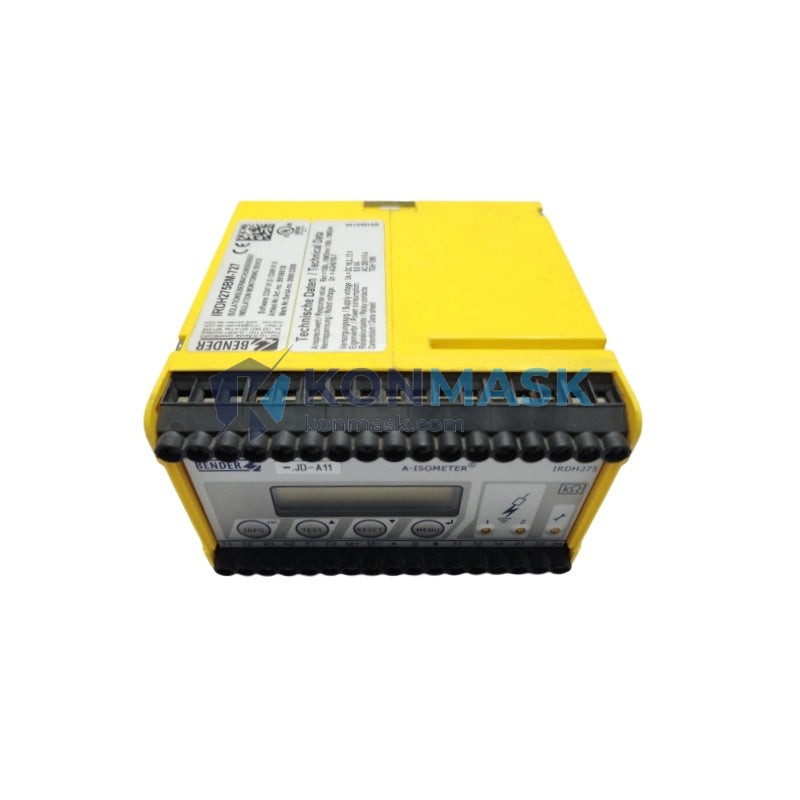
BENDER IRDH275B-435 – Insulation Monitoring Device | IRDH275 Series
The BENDER IRDH275B-435 is a precision insulation monitoring device (IMD) engineered for continuous ground-fault detection in AC, DC, and AC/DC ungrounded (IT) power systems. Designed for mission-critical environments where unplanned shutdowns are unacceptable, this device provides real-time insulation resistance monitoring with configurable alarm thresholds — enabling predictive maintenance before a fault escalates into a system failure.
As a core component of BENDER’s IRDH275 platform, the IRDH275B-435 is the preferred choice of procurement engineers specifying protection for medical facilities, renewable energy installations, marine systems, and industrial process control networks.
Complete Technical Specifications
- Part Number / SKU: IRDH275B-435
- Manufacturer: BENDER GmbH & Co. KG (Germany)
- Series: IRDH275
- Function: Insulation Monitoring Device (IMD) for IT Systems
- System Compatibility: AC, DC, and AC/DC ungrounded (IT) power systems
- Nominal System Voltage (Un): Up to 690 V AC / 1000 V DC
- Measuring Voltage: Low-level DC measuring voltage (non-interfering)
- Response Value (Ran): Adjustable 1 kΩ – 10 MΩ
- Alarm Outputs: 2 relay outputs (configurable pre-alarm and main alarm)
- Communication Interface: RS-485 (BENDER BMS protocol / Modbus RTU)
- Display: LCD with backlight, insulation resistance readout in kΩ/MΩ
- Mounting: DIN rail (35 mm) or panel mount
- Protection Class: IP30 (front panel IP40 with optional cover)
- Operating Temperature: -25 °C to +70 °C
- Power Supply: 24–240 V AC/DC (wide-range)
- Standards: IEC 61557-8, IEC 60364-4-41, UL 508
- Weight: Approx. 500 g
- Country of Origin: Germany
Proven Application Environments
- Medical & Healthcare: Operating theatres, ICUs, and diagnostic imaging suites requiring IEC 60364-7-710 compliance
- Renewable Energy: Solar PV arrays, wind turbine nacelles, and battery energy storage systems (BESS)
- Marine & Offshore: Shipboard IT systems, offshore platforms, and subsea control panels
- Industrial Process Control: Chemical plants, oil & gas facilities, and mining operations with explosive atmospheres
- Data Centers & UPS Systems: Continuous monitoring of critical DC bus and backup power rails
- Railway & Transportation: Traction power systems and rolling stock electrical networks
Engineering Advantages
- Continuous Monitoring: Real-time insulation resistance measurement without interrupting system operation — no test pulses that could disturb sensitive loads
- Wide Voltage Range: Single device covers AC and DC IT systems up to 690 V AC / 1000 V DC, reducing spare-part complexity
- Dual Alarm Thresholds: Independent pre-alarm (warning) and main alarm (critical) relay outputs allow staged response protocols
- Digital Communication: RS-485 interface enables integration with SCADA, BMS, and PLC systems via Modbus RTU or BENDER BMS protocol
- Self-Monitoring: Internal device fault detection with dedicated alarm output — meets functional safety requirements
- Compact DIN Rail Form Factor: Minimizes panel space; compatible with standard 35 mm DIN rail installations
System Architecture & Signal Flow
The IRDH275B-435 injects a low-level DC measuring voltage between the IT system conductors and earth (PE). The device continuously measures the resulting leakage current to calculate insulation resistance (Riso). When Riso falls below the configured pre-alarm or main alarm threshold, the corresponding relay de-energizes and an alarm is triggered on the LCD display and via RS-485. The measuring circuit is galvanically isolated and does not interfere with system operation or sensitive medical/instrumentation loads.
Typical wiring topology: L1/L2 (or +/−) → IRDH275B-435 measuring terminals → PE reference → relay outputs to PLC/BMS → RS-485 to supervisory system.
Sourcing & Quality Verification
- All units sourced through verified BENDER-authorized distribution channels
- Each device ships with original BENDER factory documentation and CE/UL markings
- Serial number traceable to BENDER production records upon request
- Konmask.com maintains quality inspection records for every batch received
- Counterfeit risk mitigation: holographic labels and factory packaging integrity verified before dispatch
Procurement Process
- Lead Time: In-stock units ship within 1–3 business days; ex-factory orders 4–8 weeks
- MOQ: 1 unit (no minimum order quantity for standard stock)
- Export: Available for international shipment; HS Code 8543.70 applicable
- Documentation: Commercial invoice, packing list, COO certificate, and test report available on request
- Payment: T/T, L/C, and major credit cards accepted
- RFQ: Contact support@konmask.com for volume pricing and project-specific lead times
Technical FAQ
Q: Can the IRDH275B-435 monitor both AC and DC IT systems simultaneously?
A: Yes. The device is designed for AC, DC, and combined AC/DC IT systems within its rated voltage range.
Q: What is the difference between IRDH275B-435 and IRDH275B-7?
A: The “-435” suffix denotes the specific firmware/hardware variant with RS-485 communication and wide-range power supply. Consult the BENDER datasheet for full variant comparison.
Q: Is the device compatible with Modbus RTU?
A: Yes. The RS-485 port supports both BENDER BMS protocol and Modbus RTU, enabling direct integration with most industrial PLCs and SCADA systems.
Q: Does the IRDH275B-435 require periodic calibration?
A: BENDER recommends annual functional verification per IEC 61557-8. The device includes self-monitoring to detect internal faults between scheduled checks.
Q: Can I use this device in a system with frequency converters (VFDs)?
A: Yes, with appropriate coupling/decoupling network (e.g., BENDER AGH series). Consult application engineering for VFD-heavy installations.
© 2026 Konmask.com. All rights reserved.
Original Source: https://Konmask.com
Contact: support@konmask.com | +0086 19859288691