

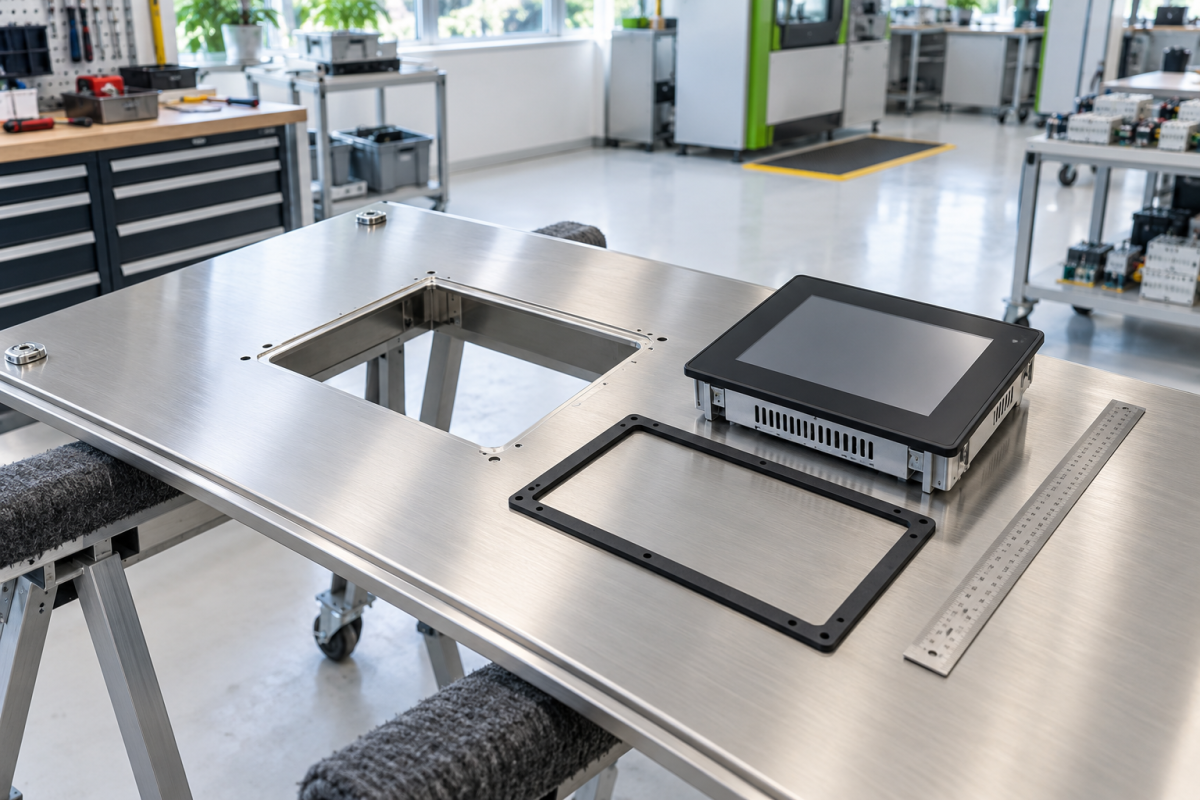
A replacement HMI can have the right screen size, display the right project and still fail the installation review. The cabinet opening is too large, the gasket lands on an uneven surface, or a rear connector collides with equipment when the door closes. These problems usually appear after purchasing has already treated the panel as a straightforward electronic replacement.
Rittal and Eplan’s October 15 announcement of a Chicago showcase scheduled for October 19 puts engineering data and physical panel construction in the same discussion. The relevance to an HMI retrofit is practical: the digital device choice must survive a mechanical review. An accurate product model is not a substitute for understanding the cabinet that will receive it.
Screen diagonal is the wrong first measurement
The display diagonal describes the viewing surface, not the opening in the door. Start with the exact installed HMI identification and its mounting drawing. Then establish the actual opening, panel thickness, door condition and the available space behind it. A cabinet that has been modified during previous repairs may no longer match the original drawing.
For example, Mitsubishi Electric publishes separate external and panel-cut dimensions for the GT2508 family. The GT25 installation documentation also addresses panel thickness and the space required around the unit, including connector and cable considerations. Use the drawing and tolerances for the exact model and applicable revision; do not transfer a measurement from another GOT size because the front appearance looks similar.
When considering a Mitsubishi GT2508-VTBD operator panel, put the physical fit review beside the electrical and project-conversion review. The product reference identifies the purchasing candidate. It does not certify an existing enclosure or prove that every previous mounting arrangement can be retained.
Inspect the opening as a sealing surface
A cutout is more than width and height. Check whether its edges and surrounding surface provide the mounting conditions required by the manufacturer. Corrosion, distortion, leftover sealant or overlapping adapter plates can complicate installation even when the nominal dimensions appear acceptable. Record photographs and measured conditions before deciding whether the existing door is suitable.
Treat the gasket and mounting hardware as functional parts of the assembly, not packaging extras. Establish what is supplied, what can be reused under the applicable instructions and what must be sourced separately. A damaged or unidentified seal should not become an invisible assumption in the purchase order.
Do not promise enclosure protection from the HMI’s catalog rating alone. The complete installed assembly depends on the panel, seal, hardware, orientation and installation conditions. Where washdown or environmental protection is important, the responsible engineer should review the full arrangement. Adding extra sealant is not a universal substitute for following the specified mounting method.
Close the door on paper first
The most useful retrofit photograph is often the inside of the door. It reveals cable ducts, reinforcing members, terminal strips and devices that are absent from the HMI drawing. Measure the available volume with the door closed and account for its movement, rather than checking only the empty opening while the cabinet is accessible.
Include the actual connectors and cables in that review. A shallow panel can require additional space once its communication plug, power connection and cable bend are considered. A connector that fits with the door open may be strained when the door closes. Maintenance access also matters: an arrangement that fits tightly can still make future replacement unnecessarily difficult.
Use a controlled fit-check drawing or an approved nonenergized mockup where needed. Do not force cables into a smaller bend or remove structural features simply to make a candidate panel fit. Any mechanical modification should follow the site’s engineering and enclosure requirements, with the equipment appropriately isolated and the work assigned to qualified personnel.
Keep three acceptance decisions separate
Mechanical fit, electrical compatibility and application behavior should have separate sign-offs. A physically acceptable panel may have a different supply requirement or communication arrangement. A correctly powered unit may still require a project conversion, revised drivers or changes to operator interaction. Passing one review should not silently close the others.
For purchasing, define the assembly boundary. Is the request for the HMI alone, the HMI with specified mounting accessories, or a completed door assembly? State whether an adapter plate is part of the approved design or merely a proposal awaiting review. This prevents a supplier’s delivery list from becoming an accidental installation specification.
At receipt, check identity, included accessories and physical condition against the order. Keep the selected model’s mounting drawing with the job package. Do not discard that package after startup: the next replacement will be easier when the as-installed opening and accessory arrangement are recorded accurately.
Questions that prevent installation surprises
Can two HMIs with the same screen size use the same cutout?
Not necessarily. Compare the exact models’ mounting drawings, tolerances and panel requirements. Screen diagonal is not a reliable proxy for bezel dimensions, cutout size or enclosure depth.
Is an adapter plate always an acceptable solution?
No. It is an engineering option that needs review for structure, sealing, mounting and environment. Its suitability depends on the complete installation, not just whether it covers an oversized hole.
Can we reuse the existing gasket?
Follow the applicable installation instructions and assess its identification and condition. Do not assume reuse is acceptable because the old panel did not visibly leak. Include required replacement accessories in the RFQ.
Does a successful project download finish the retrofit?
No. It does not prove physical fit, enclosure protection or correct machine interaction. Complete the mechanical, electrical and functional acceptance activities defined for the installation before releasing it to production.
Send the full panel model, opening dimensions, door photographs and required accessories through Konmask’s HMI sourcing inquiry. A quotation based on the actual installation gives purchasing and engineering a clearer starting point than screen size alone.
Image: AI-generated editorial illustration, not an exact product photograph or installation reference.
© 2026 Konmask. All rights reserved. Official Website: https://www.konmask.com Inquiry: support@konmask.com | WhatsApp/Tel: +86 19859288691
