

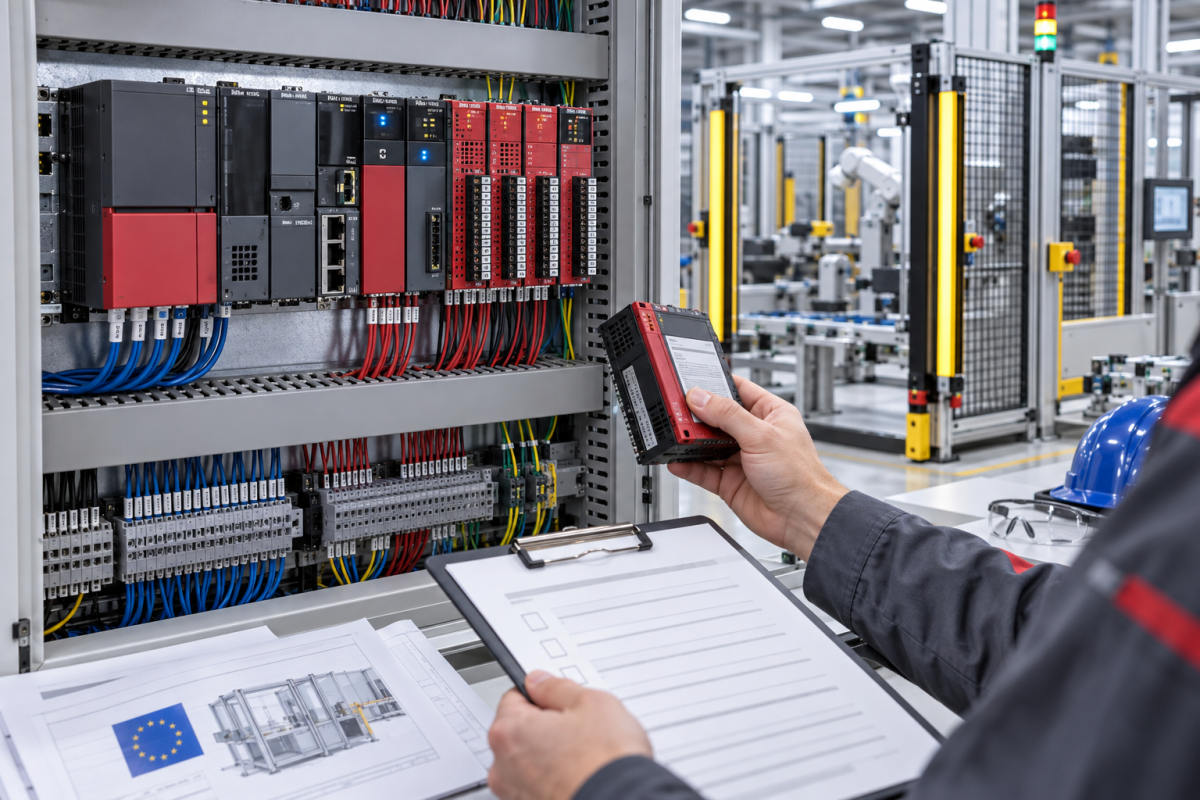
Mitsubishi Electric’s announcement that its MELSEC iQ-R safety PLC has gained EU type-examination certification under Regulation (EU) 2023/1230 is relevant to machine builders and maintenance teams for a practical reason: safety evidence is becoming more visible at the same time that many installed racks are getting older. Certification can strengthen a new design, but it does not turn an unverified replacement module into an approved spare for an existing machine.
The maintenance question is more specific. Which CPU, safety program, motion module, power supply, network path, and validation record are installed today? If a line stops, the correct response is not to order the newest-looking iQ-R item. It is to preserve the validated safety function while making the smallest controlled change.
Separate Product Certification From Installed Validation
A certification statement relates to a defined product, configuration, and intended use. An installed machine has its own guards, interlocks, emergency stops, reset behavior, risk assessment, wiring, firmware, safety program, and operating procedures. The two sets of evidence must agree before a replacement can be accepted.
Start by recording the complete CPU and module identities, safety-related parameters, firmware, project version, safety signature where used, I/O allocation, and the devices connected to each safety channel. Photograph the rack, terminal blocks, cable keys, and labels before removal. Keep the last known-good project backup with the hardware record.
Protect The CPU And The Motion Layer Together
Many machines treat the safety CPU and motion subsystem as separate procurement categories, but the restart risk often sits between them. A safe stop may depend on the motion module, drive enable chain, feedback state, and the sequence used to reset the machine. A replacement CPU with the wrong program or a motion module with a different configuration can produce a machine that powers up but cannot be released for production.
The Mitsubishi Electric R612CPU-B MELSEC iQ-R CPU module should therefore be checked against the exact rack, project, firmware, and safety role. Record whether it is a standard controller, a safety-related controller, a test unit, or a direct recovery spare. Do not use a generic “iQ-R CPU” description in the RFQ.
The same discipline applies to the MELSEC RD77MS16 iQ-R simple motion module. Confirm axis count, application data, network and drive interface, homing behavior, and the acceptance test before treating it as an equivalent. Motion data that is not backed up can turn a small CPU replacement into a long commissioning event.
Build A Safety Evidence Pack Before Shutdown
A useful safety evidence pack contains the current risk assessment, safety function list, electrical drawings, I/O list, safety program backup, signature or checksum record, firmware versions, device manuals, validation report, and photos of the actual cabinet. Add a simple table showing which component is allowed to be replaced like-for-like and which change requires engineering approval.
Store the evidence where both maintenance and controls engineering can access it during an outage. A file on a disconnected laptop is not enough. Keep a read-only copy with the spare record and record when the backup was taken and by whom.
Do Not Use Certification As A Shortcut Around Compatibility
When a vendor announces a safety certification, sales descriptions may quickly become broader than the technical scope. Check the exact part number, certification context, firmware requirements, safety function, and applicable machine boundary. Ask whether the offered item is new, surplus, refurbished, or repaired. Those conditions do not carry the same confidence, even when the model number is identical.
For an emergency quote, require the supplier to state what has been tested and what has not. The correct response may be a tested spare for immediate recovery plus a separate engineering task to move the machine toward a newer certified design. Mixing those decisions creates avoidable pressure during a shutdown.
Acceptance Testing Must Cover The Whole Safety Chain
After a replacement, test the emergency stop, guard switches, light curtains, reset logic, safe stop, feedback plausibility, drive enable, restart inhibit, fault annunciation, and operator instructions. Repeat representative production sequences and record the result. A green CPU LED and a valid online connection are not proof that the machine’s safety function is intact.
Where the machine has multiple modes, test setup, manual, automatic, maintenance, and recovery modes. Check the conditions under which an operator can reset the system and confirm that a power cycle does not create an unexpected restart path. Attach the test record to the new serial number.
What Procurement Should Put In The RFQ
Include complete model numbers, rack position, firmware, safety role, project version, quantity, acceptable condition, required test evidence, destination, and delivery date. Add photos of the nameplate, connectors, keying, neighboring modules, and the cabinet. State whether an exchange unit is acceptable and whether the supplier must provide serial-number traceability.
Ask for two lines when appropriate: direct recovery hardware and an approved modernization alternative. That distinction keeps a machine safe today while allowing the engineering team to evaluate a future design without rushing the outage decision.
FAQ
Does iQ-R safety certification automatically approve a replacement in my machine?
No. The machine’s safety functions, risk assessment, project, firmware, wiring, and validation still have to be checked for the actual installation.
Why do motion modules matter in a safety PLC spare plan?
Motion behavior can be part of the stop and restart sequence. Axis data, drive enable, feedback, and homing behavior should be preserved and tested with the CPU change.
What is the minimum evidence to keep before removing the CPU?
Keep the complete labels, rack photos, project and safety backups, firmware information, safety signature if used, wiring drawings, fault history, and the last validation record.
Should a refurbished safety module be rejected automatically?
Not automatically, but its test scope, provenance, serial number, condition, and acceptance criteria must be clear. Safety approval belongs to the responsible engineering process.
Request a quote: Send Konmask the full iQ-R part number, safety role, firmware and project evidence, cabinet photos, quantity, required condition, destination, and deadline so the sourcing team can return a controlled option.
© 2026 Konmask. All rights reserved. Official Website: https://konmask.com Inquiry: support@konmask.com
