
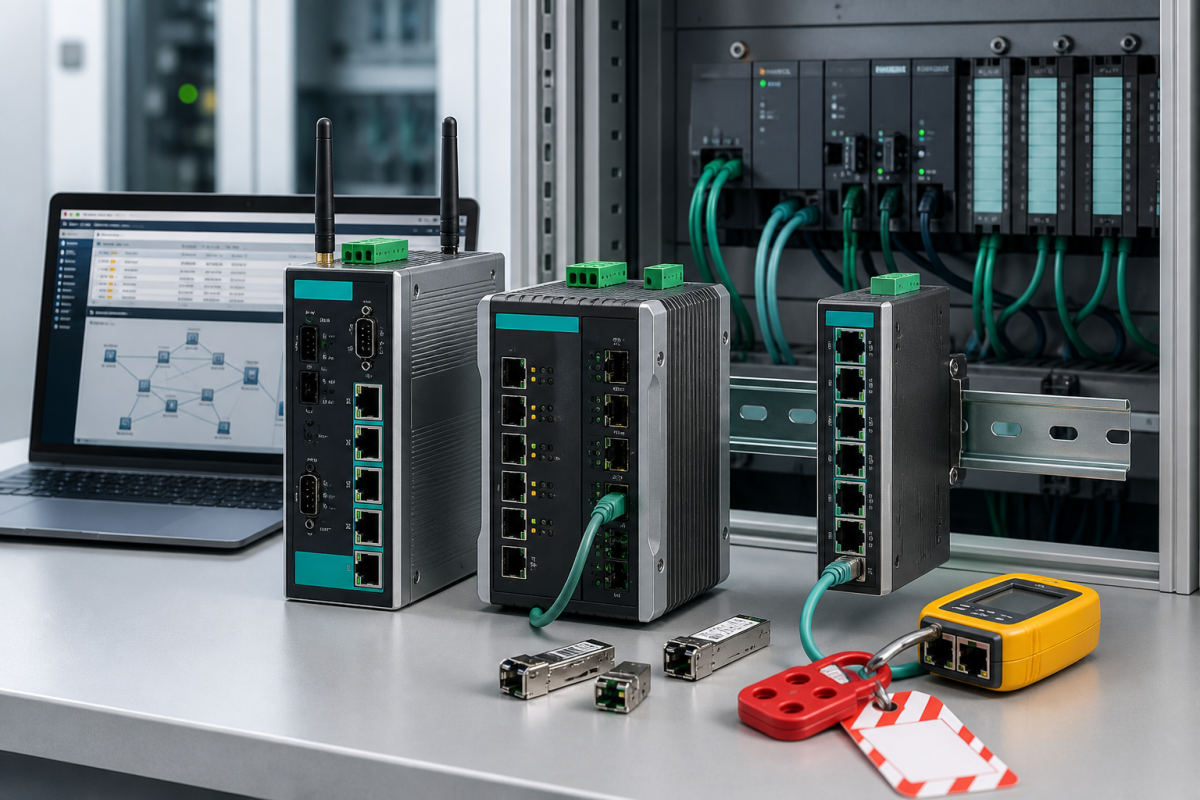
A secure router sits in an uncomfortable place: procurement sees hardware, cybersecurity sees policy, and maintenance sees the plant that must keep running. After an OT exposure review, a MOXA EDR-810 spare should be selected with the firewall role, port map, firmware, SFPs, power, topology, and recovery test already documented.
Konmask readers need cybersecurity actions that do not break operations. A router replacement can restore segmentation or remote access only if the spare matches both the physical network and the approved security behavior.
Document The Security Role First
Record firewall or routing role, port map, WAN/LAN separation, SFP use, power input, firmware, rule backup, VPN or remote-access dependency, cabinet location, and affected PLC or SCADA nodes.
The live MOXA EDR-810-2GSFP industrial secure router is the product match when the RFQ concerns secure segmentation at a control cabinet boundary.
Photograph labels, port assignments, fiber modules, power terminals, grounding, cable tags, rule-backup evidence, and any security or network alarm before replacement.
Temperature And SFP Details Can Change The Spare
A similar router may have different temperature rating, SFP support, firmware, enclosure limits, or accessory requirements. Those details matter in remote utility cabinets.
The related MOXA EDR-810-2GSFP-T industrial secure router shows why environmental suffix and port evidence should be explicit.
Ask suppliers to separate hardware condition from configuration support. A powered router is not ready if the firewall rules, firmware, and topology behavior are unknown.
Acceptance Must Include Security And Traffic
After replacement, verify link state, firewall rules, allowed PLC traffic, blocked unwanted traffic, remote access, alarm behavior, time sync, and a controlled operational test.
If traffic fails, review SFP type, port mapping, NAT or firewall rules, VLANs, firmware, certificate or VPN settings, and cable quality before rejecting the spare.
Store topology, photos, backup files, firmware notes, and cybersecurity approval with the spare record.
RFQ Evidence That Reduces Downtime
Send labels, port photos, topology, firewall role, firmware evidence, SFP details, condition requirement, and recovery deadline.
A secure-router RFQ should clearly separate hardware availability from configuration responsibility.
For substitutes, require review of security rules, routing behavior, environmental rating, power, and acceptance testing.
The core discipline is simple: prove identity, prove function, and prove acceptance. Identity confirms the installed hardware. Function explains what the plant expects the spare to restore. Acceptance defines how maintenance will know the replacement is ready for service.
This matters because mature automation platforms rarely fail in isolation. A module, cable, terminal, firmware note, project backup, cabinet power path, and field device can all shape the same symptom. The RFQ should keep those dependencies visible instead of reducing the request to a copied title.
Actual-item photos are still one of the fastest ways to remove uncertainty. Front labels, side labels, connector faces, terminal assemblies, memory devices, handles, latch points, and accessory scope often expose differences that a catalog description hides.
Condition language should be precise. New surplus, factory sealed, refurbished, repaired exchange, tested used, and untested used parts should not be compared as if they had the same risk. Ask what was tested and what remains a site responsibility.
For urgent downtime, define the fallback before ordering. If the item fails bench or field acceptance, the plant should know whether to reinstall the old unit, try a repaired exchange, isolate a noncritical function, or escalate toward migration.
Finally, keep the purchasing evidence with the spare after it arrives. If the evidence disappears into email, the next engineer has to repeat the same investigation under more pressure. A good spare record saves time twice: once during sourcing and again during the restart.
Receiving inspection should repeat the same evidence check. Compare the approved photos with the received item, confirm connector condition, verify included accessories, record visible damage, and keep packaging notes when the item has fragile terminals, exposed boards, probes, displays, or communication ports.
The request should also state what the supplier is not being asked to prove. If field configuration, software loading, safety validation, or final loop testing remains the plant responsibility, say so clearly. Clear boundaries reduce confusion when the maintenance window is already open.
For plants with several similar systems, include the installed unit or machine name. A spare that fits one package skid, turbine train, boiler burner, or PLC rack may not be suitable for the next cabinet even when the brand and family appear the same.
If lifecycle pressure is part of the discussion, record it without exaggeration. Scarcity, weak test evidence, missing accessories, or frequent substitution requests are useful signals for migration planning, but they should be supported by sourcing facts rather than assumptions.
Good RFQs do not slow the job down. They remove vague follow-up questions and give the supplier a fair chance to confirm exact stock, repaired exchange options, substitution limits, and realistic dispatch timing before the plant commits to a recovery path.
FAQ
What must match on a MOXA EDR-810 spare?
Match port count, SFP scope, power, firmware, firewall role, topology, environmental rating, and configuration backup.
Can an unmanaged switch replace a secure router temporarily?
Usually no. It may restore links while removing segmentation, firewall rules, and approved remote-access controls.
What should procurement send?
Send labels, port map, SFP photos, topology, firmware notes, rule-backup status, condition requirement, and deadline.
What proves recovery?
Allowed traffic works, blocked traffic remains blocked, PLC/HMI communication is restored, logs are healthy, and OT approval is recorded.
Send Konmask the MOXA labels, topology, port photos, rule-backup status, firmware evidence, condition requirement, and recovery deadline. We can help prepare a secure-router RFQ.
© 2026 Konmask. All rights reserved. Official Website: https://konmask.com Inquiry: support@konmask.com | WhatsApp/Tel: +86 18359293191
