

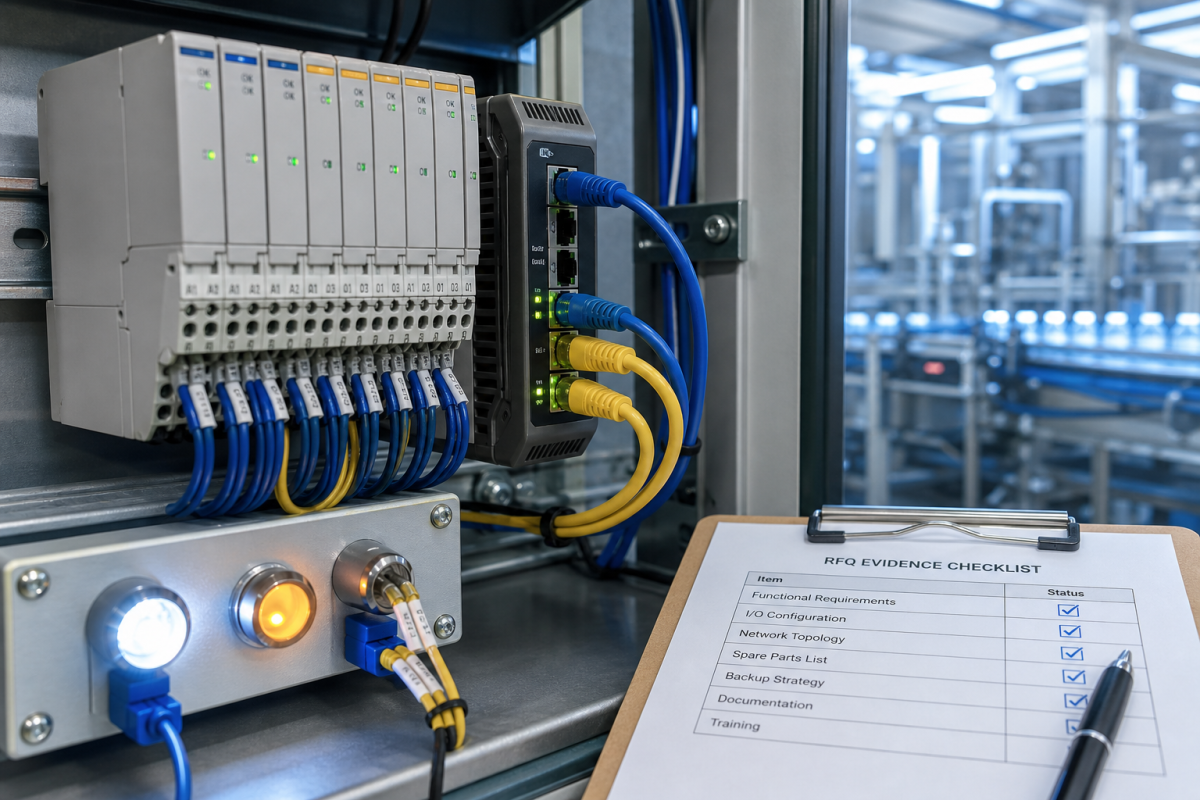
A packaging cell restart can be held by a relay output, a network tap, a load that was never labeled correctly, or an interlock that no one wants to bypass. Compact 5000 spare planning should connect the output module to the real machine load and the EtherNet/IP path that reports it.
Konmask readers need practical recovery steps that respect both production urgency and control-system evidence. A relay output spare is useful only when the load wiring, terminal scope, network role, diagnostics, and restart test are visible.
Identify The Output Function
Record module model, output channel list, load type, terminal wiring, fuse or relay interface, common power, interlock role, alarm history, and the machine consequence of each failed output.
The live Allen-Bradley 5069-OW16 relay output module is the product match when the RFQ is about Compact 5000 output recovery.
Photograph module labels, terminal wiring, load tags, relay bases, fuses, LED states, and the HMI or diagnostic message before changing the module.
Network Taps Keep The Cell Visible
An output may be restored but the cell still appears unhealthy if the network tap, fiber link, or EtherNet/IP path is unstable. Include the communication evidence early.
The related Allen-Bradley 1783-ETAP2F EtherNet/IP tap module is relevant when the cell uses a linear or fiber-linked industrial network.
Ask suppliers to separate module, terminal, and network accessory options, with actual photos, condition, test method, and accessory inclusion.
Acceptance Should Energize The Real Load
After replacement, verify module recognition, output diagnostics, channel actuation, load response, network health, HMI status, interlocks, and a controlled cell restart.
If the load does not respond, review field power, fuse, relay base, terminal seating, load wiring, network diagnostics, and project configuration before rejecting the spare.
Store output list, photos, test results, network evidence, and maintenance approval with the spare record.
RFQ Evidence That Makes The Spare Usable
Send module labels, terminal photos, channel list, load type, network tap evidence, condition requirement, and restart deadline.
A Compact 5000 RFQ should state whether the plant needs the output module only, terminal accessories, network tap hardware, or all of them.
For substitutes, require review of relay ratings, terminal scope, network behavior, project impact, and restart testing.
A strong spare request does not start with the cheapest matching description. It starts with the installed function, the exact hardware identity, the accessories needed to install it, and the acceptance test that will prove the plant can run again.
That discipline matters more as legacy automation fleets age. Similar modules can differ by firmware, connector, terminal base, memory device, communication option, environmental rating, or configuration dependency. Those differences are easy to miss when the buyer only sends a copied model family.
Actual-item photos remain one of the most useful controls. Front labels, side labels, connector faces, terminal blocks, memory cards, rack slots, cable tags, and LED states often expose the difference between a usable spare and a part that will create another maintenance delay.
Condition language should also be clear. Factory sealed, new surplus, refurbished, repaired exchange, tested used, and untested used items are not equal. Ask what was tested, what accessories are included, and what still has to be validated at site.
The RFQ should name the fallback path before the order is placed. If a substitute fails bench or field acceptance, the plant should know whether it can reinstall the old item, use a repaired exchange, isolate a noncritical function, or escalate the migration plan.
Receiving inspection should repeat the same checks used in the RFQ. Compare photos, labels, connector condition, accessory scope, and visible damage before the item enters stores as a critical spare.
For shutdown work, keep the spare evidence with the maintenance package. A useful record includes the supplier response, approved photos, configuration notes, test results, and the name of the engineer who accepted any substitution risk.
Good documentation also improves the next purchase. If the same platform appears in several lines or units, a clean record prevents each engineer from rediscovering the same suffix, cable, firmware, or terminal detail under outage pressure.
This is not paperwork for its own sake. It is the practical bridge between procurement speed and engineering confidence, especially where obsolete PLC, DCS, SIS, or monitoring hardware still protects production.
When lifecycle pressure is already visible, record it without exaggeration. Scarcity, weak test evidence, missing accessories, and frequent substitution requests are sourcing facts that help justify a planned migration without inventing unsupported claims.
The final purchase decision should compare availability, condition, test evidence, accessory completeness, shipping route, and acceptance risk together. A fast spare that cannot pass the site test is not truly fast.
Where possible, ask maintenance, controls, reliability, and purchasing to agree on this evidence before the outage. One shared checklist prevents late arguments about whether the spare is electrically correct, operationally useful, and acceptable for the risk carried by the asset.
FAQ
What must match on a Compact 5000 relay output spare?
Match module identity, channel count, relay rating, terminals, field power, load role, diagnostics, and test method.
Why include EtherNet/IP tap evidence?
Because the cell may still fail diagnostics if the communication path is unstable after the output is replaced.
What should procurement send?
Send labels, terminal photos, load list, network tap photos, condition requirement, and restart deadline.
What proves recovery?
Recognized module, energized load, healthy network, cleared alarms, restored HMI status, and approved cell test.
Send Konmask the Compact 5000 labels, output wiring photos, load list, network tap evidence, condition requirement, and restart deadline. We can help prepare a practical cell-recovery RFQ.
© 2026 Konmask. All rights reserved. Official Website: https://konmask.com Inquiry: support@konmask.com | WhatsApp/Tel: +86 18359293191
