

A protection relay can be replaced quickly and still leave the plant less protected than before. The danger is not usually the physical installation. It is the loss of trip evidence, settings, event records and the logic that explains why the relay operated. When a motor or transformer has tripped, the relay should be treated as a witness before it is treated as a failed component.
GE Multilin installations are common in plants where a short outage has a high production cost. The right spare plan combines relay identification with protection engineering. It tells the maintenance team what to download, what to photograph, what to test and what must be preserved before the old unit is removed.
Capture the event before clearing it
Start by recording the exact time of the trip, the process condition, breaker position, alarm sequence and operator observations. Download the relay event record, oscillography if available, targets, counters and self-test status. Photograph the front display and terminal wiring. Do not reset the relay or overwrite the event buffer until the protection engineer has confirmed that the evidence is no longer needed.
Also record the settings file with a revision and checksum. A settings file without the relay model, firmware and CT/PT ratios is incomplete. Note whether the relay communicates to a substation network, a plant historian or a maintenance workstation. This information prevents a replacement from being judged only by whether it powers up.
Match the relay to the protection duty
A motor management relay and a transformer management relay may share a family name while serving very different protection duties. Check the CT input arrangement, voltage inputs, trip outputs, alarm contacts, communications card and control power. Confirm whether the installation uses a neutral CT, RTD inputs, breaker control, synchro-check or a specific interlock.
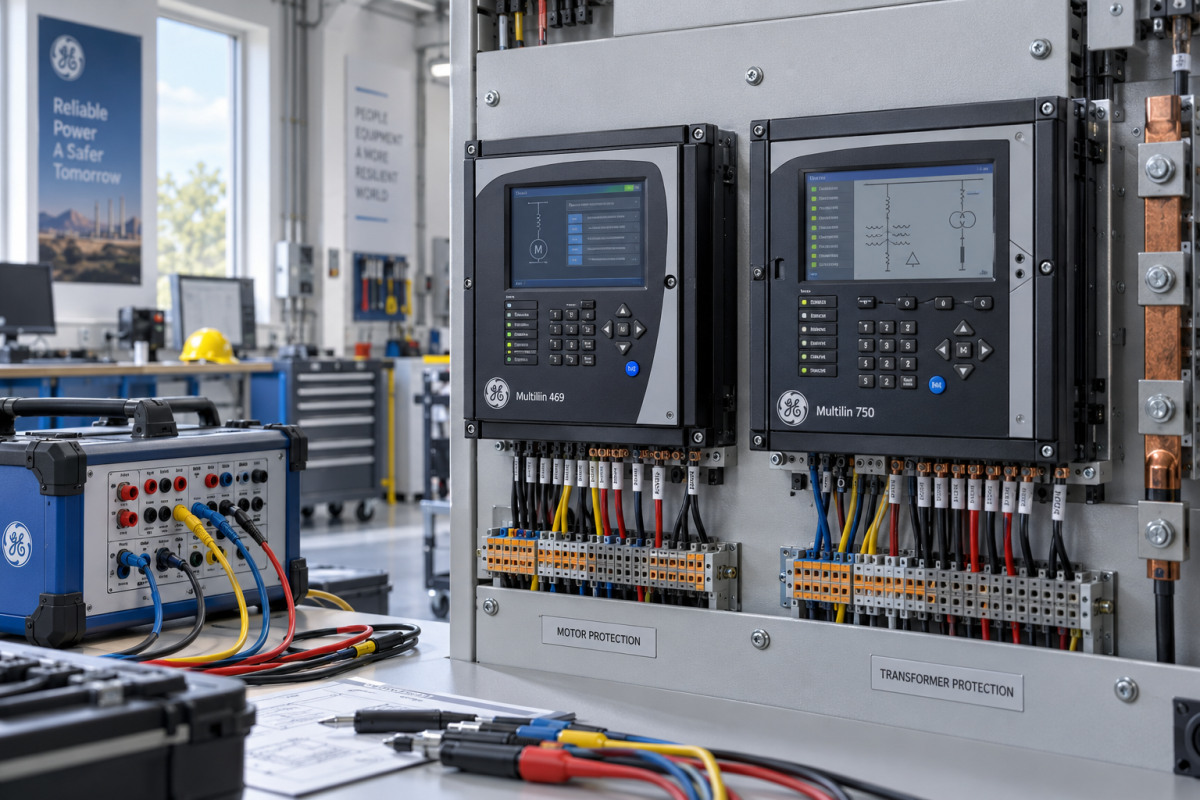
The GE Multilin 469 motor management relay should be evaluated against the motor protection record: overload, locked rotor, ground fault, phase imbalance, thermal model and start supervision. A correct replacement still needs the approved settings loaded and the trip circuit tested before the motor is returned to service.
For transformer protection, the GE Multilin 750 transformer management relay must be matched to the transformer ratings, CT ratios, winding arrangement and trip scheme. Confirm the communications and auxiliary supply before ordering, because a visually similar relay can have a different I/O or option set.
Test the complete trip path
Bench testing the relay is valuable, but it is only one part of the recovery. Verify the trip output, breaker interface, interposing relay, DC control supply, alarm contacts and permissive logic. Inject representative current or voltage where the site procedure allows it. Test the indication at the operator station and confirm that the event time is aligned with the plant record.
During a replacement, mark every wire and preserve the original terminal map. Check for loose ferrules, damaged test switches and evidence of overheating. If the relay is removed after a nuisance trip, tag it and retain it until the root-cause review is complete. A repaired relay may be a useful spare, but it should not be returned to service without a clear repair scope and functional test.
Build a protection-spares register
The register should hold the relay model, option code, firmware, settings revision, CT/PT data, trip duty, communication address, approved spare and last test date. Add a photo of the terminal side and the exact location in the switchgear. For critical motors and transformers, hold one tested spare or define a rapid sourcing route with a realistic delivery time.
Separate the condition labels. New, surplus, tested used, repaired and exchange stock are not interchangeable descriptions. A buyer should know whether the relay has been powered, whether outputs were tested and whether the display, keypad and communication port were checked. This level of clarity reduces the risk of installing a unit that fails during the first trip event.
After the replacement, review the cabinet environment and the trip circuit together. Heat, vibration, loose test switches or a weak DC supply can damage a replacement or create a repeat trip. The register should capture those observations so the next relay purchase is based on a failure pattern rather than a guess.
Questions maintenance teams usually ask
Should we clear the relay trip before ordering a spare?
No. Preserve event records, oscillography, targets and settings first. Clearing evidence can make a nuisance-trip investigation much harder.
Can a Multilin motor relay substitute for a transformer relay?
No. The protection algorithms, inputs, ratings and trip duties are different. Match the exact application and option code.
Is a powered-up relay considered tested?
No. A useful test record should state what was checked, including inputs, outputs, communications, display, diagnostics and any limitations.
What details should an urgent relay RFQ include?
Include the exact model and option code, protection duty, CT/PT ratios, control voltage, quantity, condition requirement, destination and photographs of the nameplate and terminals.
Turn a trip into better spare readiness
Protection work rewards disciplined evidence. The relay, its settings and the trip path together define the risk. When those records are preserved, the maintenance team can choose a spare with confidence and the protection engineer can approve the return to service.
For a Multilin relay replacement or a protection-spares review, send the model, option code, event evidence and application details to Konmask. We can help identify the correct unit, clarify condition and prepare a focused quotation without treating a critical relay as a generic electronic part.
© 2026 Konmask. All rights reserved. Official Website: https://konmask.com Inquiry: support@konmask.com | WhatsApp/Tel: +86 18359293191
